.
The Air Contains Honey at Les Salons acoustiques
Sunday, March 27th at 4pm
La Chapelle Scènes Contemporaines
Order your tickets here: https://lachapelle.org/en/schedule/jacob-wren-adam-kinner-this-air-contains-honey
The Air Contains Honey is an “orchestra” that mixes professional and amateur musicians in search of a warmth and community spirit they may or may not find. All of their songs follow the same basic structure: a quote sung four times, an instrumental break, and then the same quote sung another four times. For the audience, as well as for the performers, this is a chance to hear an orchestra in the process of discovering its sound as it goes.
Featuring a combination of some or all of the following people: Nadia Chaney, Patrick Conan, Catherine Fatima, Michael Feuerstack, James Nicholas Dumile Goddard, Hanako Hoshimi-Caines, Thanya Iyer, Adam Kinner, Liam O’Neill, Lara Oundjian, Pompey, Stephen Quinlan, Rebecca Rehder, Erin Robinsong, Frédérique Roy, Jacob Wren (and possibly a few others.)
(The Air Contains Honey don’t perform very often. Don’t miss your chance.)
Facebook Event
.
February 26, 2022
February 10, 2022
lowercase pamphlets & Sentences Written Over Time
.
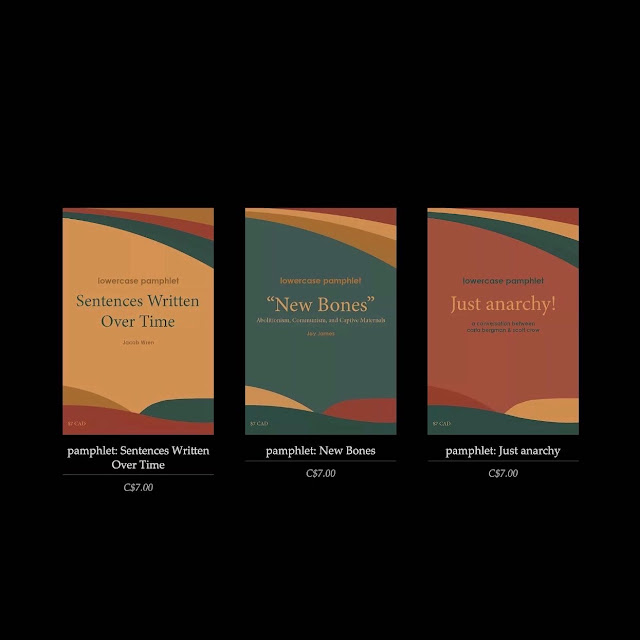
I am happy to have my work be one of the first three lowercase pamphlets:
Sentences Written Over Time by Jacob Wren
New Bones: Abolitionism, Communism, and Captive Maternals by Joy James
Just anarchy: a conversation between carla joy bergman and scott crow
*
lowercase pamphlets (so far) are curated by carla bergman and chris time steele
Graphics and layout design by Maia Anstey and carla bergman, with support by Jamie Leigh Gonzales, and printed by Listening House Media.
lowercase pamphlets range in scope and topics, but are rooted in amplifying kinetic ideas. A common thread throughout the series is the writers are sure to inspire.
Themes from forthcoming pamphlets include, abolition, colonial time, autonomy, feminisms, madness, anarchy, and much more.
The pamphlets in their unique ways share stories of justice and freedom for all. Plus the pamphlets look cool.
Why pamphlets? Because we’re trying to find each other outside of the algorithms that seek to divide us. We think pamphlets are sometimes the perfect size for hashing out an idea in an accessible and fun way.
.
I am happy to have my work be one of the first three lowercase pamphlets:
Sentences Written Over Time by Jacob Wren
New Bones: Abolitionism, Communism, and Captive Maternals by Joy James
Just anarchy: a conversation between carla joy bergman and scott crow
*
lowercase pamphlets (so far) are curated by carla bergman and chris time steele
Graphics and layout design by Maia Anstey and carla bergman, with support by Jamie Leigh Gonzales, and printed by Listening House Media.
lowercase pamphlets range in scope and topics, but are rooted in amplifying kinetic ideas. A common thread throughout the series is the writers are sure to inspire.
Themes from forthcoming pamphlets include, abolition, colonial time, autonomy, feminisms, madness, anarchy, and much more.
The pamphlets in their unique ways share stories of justice and freedom for all. Plus the pamphlets look cool.
Why pamphlets? Because we’re trying to find each other outside of the algorithms that seek to divide us. We think pamphlets are sometimes the perfect size for hashing out an idea in an accessible and fun way.
.
February 6, 2022
MACHO INTELECTUAL by INVASORIX
I studied with a macho-macho-man
He was a very popular teacher
HE WAS AN INTELLECTUAL MACHO
He impressed with his subjectivity
and everybody wanted to listen to him
DON’T PLAY DUMB
HE WAS AN INTELLECTUAL MACHO
He spoke to me about Foucault,
about discipline and punishment
And he just wanted to shut me up
to fuck me up and fuck me, to educate and dominate me,
to annoy and humiliate me, to bend me over and break me
to impress, flirt, outshine, confuse me
lecture me, bluff and indoctrinate me
He spoke to me about Ranciere, too.
I worked with a macho-macho-man
He was a cool guy
HE WAS AN INTELLECTUAL MACHO
He spoke to me about struggle and self-determination
about anarchy and polyamory
DON’T PLAY DUMB
HE WAS AN INTELLECTUAL MACHO
You never stop talking
You never listen
and you only seek to stand out
HE WAS A PROGRESSIVE,
GESTURAL, RELATIONAL, GLOBAL-LOCAL,
MEDIEVAL, ENIRONMENTAL, HEDONIST,
ACTIVIST-ELITIST, VIRTUAL, CONCEPTUAL,
SPIRITUAL, INTERNATIONAL ARTIST
SITUATIONIST
I came across a macho-girl
She was a potential sister
SHE WAS AN INTELLECTUAL MACHO
We mistook fraternity
for ambition and competition
HERE, WHO IS, HERE, WHO IS THE INTELLECTUAL MACHO
We are sick of competing,
of self-sabotaging
of abuses of power
I don’t sell myself, I don’t exploit myself, I don’t let myself get fooled
Don’t hide, don’t pretend, don’t let yourself be censored
I don’t sell myself, I don’t exploit myself, I don’t let myself get fooled
Don’t hide, don’t pretend, don’t let yourself be censored
[You can find more INVASORIX here: https://invasorix.tumblr.com]
.
Labels:
INVASORIX
January 17, 2022
Hey! Listen to me! I'm on the stereo!
.
Thanks so much to Nantali Indongo and CBC's The Bridge for having me on air the other day.
We talked about Cheap Trick, Beverly Glenn-Copeland, PME-ART, Vulnerable Paradoxes, Every Song I've Ever Written, Zoom meetings, being on tour, my Instagram, child star syndrome and so much more.
[As well, if you want to check out Momus covering the songs I wrote when I was a teenager you can find the playlist here.]
[And if the title of this post doesn't mean anything to you, you might want to listen to this.]
.
Thanks so much to Nantali Indongo and CBC's The Bridge for having me on air the other day.
We talked about Cheap Trick, Beverly Glenn-Copeland, PME-ART, Vulnerable Paradoxes, Every Song I've Ever Written, Zoom meetings, being on tour, my Instagram, child star syndrome and so much more.
[As well, if you want to check out Momus covering the songs I wrote when I was a teenager you can find the playlist here.]
[And if the title of this post doesn't mean anything to you, you might want to listen to this.]
.
Labels:
Jacob Wren,
Nantali Indongo,
The Bridge
January 13, 2022
My column in The Society for the Diffusion of Useful Knowledge
.
I was happy to have a column in SDUK (The Society for the Diffusion of Useful Knowledge) published by The Blackwood Gallery. These are the three instalments:
The First Chapter
In Support of the Censure
In Spite of Defeatism
.
I was happy to have a column in SDUK (The Society for the Diffusion of Useful Knowledge) published by The Blackwood Gallery. These are the three instalments:
The First Chapter
In Support of the Censure
In Spite of Defeatism
.
January 8, 2022
Two short passages from Hospitality Matters: Un entretien avec PME-ART
.
I have such a strong belief in collaboration: as something thematically essential, as a place to make artistic breakthroughs that are simply impossible to make on one’s own, as a way to attempt to break our culture’s (and art’s) incredible over-emphasis on individualism and the individual artist, as a way to be a little bit less alone in the world. At the same time, I generally find the actual lived experience of collaboration to be incredibly difficult. Perhaps psychologically I’m not really made for it. I guess there’s a lot of tension in this paradox, and some of that tension must be what energizes the work. As I was writing this, a strange sentence suddenly popped into my head: the work of PME-ART is both too collaborative and not collaborative enough. There is something off-kilter about our way of collaborating with others, and out of this something I believe a different kind of performance might emerge.
*
Yes, I like that way of putting it, our “performances are also about escaping performance,” but I think for me this is almost true of everything that has value, that it somehow needs to attempt to transcend previous conceptions of what it might be or become. I believe somewhere Alain Badiou says philosophy must also embrace anti-philosophy, and that has something to do with my approach as well: performance must also embrace anti-performance, and also embrace everything else as well, everything that’s outside of performance, so much of life that most performance so casually ignores. I want something unexpected to happen, to be surprised, and to surprise myself.
“Finding ways to make performances incapable” is also a formulation I’m very much attracted to. I think, for me, this also has something to do with life: I don’t feel I’m able to live and yet I somehow continue to live anyway. Sometimes I say that I’m good at art, bad at life. And this feeling forces me to live my struggles with life within art, within performance. So the performance can never feel okay, there is so much conflict, difficulty, ambiguity, uncertainty in my relations towards it, and in the act of performing it in public, in front of people who might very well find life so much easier than I do. On the other hand, perhaps many of them find it just as difficult. Performance (or whatever we wish to call it) might be one of the places where we can find out.
You can read the full interview here: Hospitality Matters: Un entretien avec PME-ART
.
I have such a strong belief in collaboration: as something thematically essential, as a place to make artistic breakthroughs that are simply impossible to make on one’s own, as a way to attempt to break our culture’s (and art’s) incredible over-emphasis on individualism and the individual artist, as a way to be a little bit less alone in the world. At the same time, I generally find the actual lived experience of collaboration to be incredibly difficult. Perhaps psychologically I’m not really made for it. I guess there’s a lot of tension in this paradox, and some of that tension must be what energizes the work. As I was writing this, a strange sentence suddenly popped into my head: the work of PME-ART is both too collaborative and not collaborative enough. There is something off-kilter about our way of collaborating with others, and out of this something I believe a different kind of performance might emerge.
*
Yes, I like that way of putting it, our “performances are also about escaping performance,” but I think for me this is almost true of everything that has value, that it somehow needs to attempt to transcend previous conceptions of what it might be or become. I believe somewhere Alain Badiou says philosophy must also embrace anti-philosophy, and that has something to do with my approach as well: performance must also embrace anti-performance, and also embrace everything else as well, everything that’s outside of performance, so much of life that most performance so casually ignores. I want something unexpected to happen, to be surprised, and to surprise myself.
“Finding ways to make performances incapable” is also a formulation I’m very much attracted to. I think, for me, this also has something to do with life: I don’t feel I’m able to live and yet I somehow continue to live anyway. Sometimes I say that I’m good at art, bad at life. And this feeling forces me to live my struggles with life within art, within performance. So the performance can never feel okay, there is so much conflict, difficulty, ambiguity, uncertainty in my relations towards it, and in the act of performing it in public, in front of people who might very well find life so much easier than I do. On the other hand, perhaps many of them find it just as difficult. Performance (or whatever we wish to call it) might be one of the places where we can find out.
You can read the full interview here: Hospitality Matters: Un entretien avec PME-ART
.
Labels:
Jacob Wren,
PME-ART,
Quotes
December 18, 2021
Some passages from We Do This 'Til We Free Us by Mariame Kaba
Some passages from We Do This 'Til We Free Us: Abolitionist Organizing and Transforming Justice by Mariame Kaba:
*
So, maybe I just have a different perspective and I talk to a lot of young organizers - people reach out to me a lot because I’ve been organizing for a long time - I’m always telling them, “Your timeline is not the timeline on which movements occur. Your timeline is incidental. Your timeline is only for yourself to mark your growth and your living.” But that’s a fraction of the living that’s going to be done by the universe and that has already been done by the universe. So, when you understand that you’re really insignificant in the grand scheme of things, you just are, then it’s a freedom, in my opinion, to actually be able to do the work that’s necessary as you see it and to contribute in the ways that you can see fit. So, I think that’s my answer to that.
And self-care is really tricky for me, because I don’t believe in the self in the way that people determine it here in this capitalist society that we live in. I don’t believe in self-care, I believe in collective care, collectivizing our care, and thinking more about how we can help each other. How can we collectivize the care of children so that more people can feel like they can actually have their kids but also live in the world and contribute and participate in various different kinds of ways? How do we do that? How do we collectivize care so that when we’re sick and we’re not feeling ourselves, we’ve got a crew of people that are not just our prayer warriors, but our action warriors who are thinking through with us? Like, I’m not just going to be able to cook this week, and you have a whole bunch of folks there, who are just putting a list together for you and bringing the food every day that week and you’re doing the same for your community, too.
I want that as the focus of how I do things and that really comes from the fact that I grew up the daughter of returned migrants, African-returned migrants. I don’t see the world the way that people do here, I just don’t. I don’t agree with it, I think capitalism is actually continuously alienating us from each other, but also even from ourselves and I just don’t subscribe. And for me, it’s too much with, “Yeah I’m going to go do yoga and then, I’m going to go and do some sit-ups and maybe I’ll like, you know, go to…” You don’t have to go anywhere to care for yourself.
You can just care for yourself and your community in tandem and that can actually be much more healthy for you, by the way. Because all this internalized, internal reflection is not good for people. You have to be able to have… Yes, think about yourself, reflect on your practice, okay, but then you need to test it in the world, you’ve got to be with people. So, that’s important. And I hate people! So, I say that as somebody who actually is really anti-social… I don’t want to socialize in that kind of way but I do want to be social with other folks as it relates to collectivizing care.
*
You can’t force somebody into being accountable for things they do. That is not possible. People have to take accountability for things that they actually do wrong. They have to decide that this is wrong. They have to say, “This is wrong and I want to be part of making some sort of amends or repairing this or not doing it again.” The question is: What in our culture allows people to do that? What are the structural things that exist? What in our culture encourages people who assault people and harm people to take responsibility? What I see is almost nothing.
*
Not only is it true that punishment doesn’t work, but also when you prioritize punishment it means that patriarchy remains firmly in place. And if I am at my core interested in dismantling systems of oppression, I have got to get rid of punishment. I have got to do it. But I want accountability. I want people to take responsibility. I want that internal resource that allows you to take responsibility for harms that you commit against yourself and other people. I want that to be a central part of how we interact with each other. Because while I don’t believe in punishment, I believe in consequences for actions that are done to harm other people. I do. I think boundaries are important. I think all these things are really important. But with punishment at the centre of everything we haven’t been able to really address the other stuff that needs to happen. Because people fucking need to – they need to take accountability when they harm people.
*
Oh my gosh. You’re asking me great hard questions. I keep threatening to write an essay called “Abolition Is Not About Your Fucking Feelings.” I wrote that in a tweet and got so much blowback because people felt like I was insulting their ability to feel what they want to feel. That’s really not what I’m saying. The concept of the personal being political as a basis for feminist organizing in the past is so true, and yet it is so fraught at the same time. What it’s not saying – and I think what sometimes people want it to be saying – is that how I personally feel then should be made into policy. And we can’t operate in a world where that’s true. We shouldn’t codify our personal feelings of vengeance to apply to the entire world.
*
Also, I really feel like over the years I’ve learned myself better. And that helps you to figure out what your actual boundaries are. And also, boundaries are usually a negotiation between what you want and what other people want. It’s not like a firm, set thing. You have to get really good at being able to negotiate. And the only way to do that is to know who you are.
*
It’s like, why? You’re going to burn out. It’s not humanly possible for you to just be your Lone Ranger self out there in the world. Ella Baker’s question “Who are your people?” when she would meet you is so important. Who are you accountable to in this world? Because that will tell me a lot about who you are.
And how much hubris must we have to think that we, as individuals, will have all the answers for generations’ worth of harm built by millions and millions of people? It’s like I’m on a five-hundred-year clock right now. I’m right here knowing that we’ve got a hell of a long time before we’re going to see the end. Right now, all we’re doing as organizers is creating the conditions that will allow our collective vision to take hold and grow.
.
*
So, maybe I just have a different perspective and I talk to a lot of young organizers - people reach out to me a lot because I’ve been organizing for a long time - I’m always telling them, “Your timeline is not the timeline on which movements occur. Your timeline is incidental. Your timeline is only for yourself to mark your growth and your living.” But that’s a fraction of the living that’s going to be done by the universe and that has already been done by the universe. So, when you understand that you’re really insignificant in the grand scheme of things, you just are, then it’s a freedom, in my opinion, to actually be able to do the work that’s necessary as you see it and to contribute in the ways that you can see fit. So, I think that’s my answer to that.
And self-care is really tricky for me, because I don’t believe in the self in the way that people determine it here in this capitalist society that we live in. I don’t believe in self-care, I believe in collective care, collectivizing our care, and thinking more about how we can help each other. How can we collectivize the care of children so that more people can feel like they can actually have their kids but also live in the world and contribute and participate in various different kinds of ways? How do we do that? How do we collectivize care so that when we’re sick and we’re not feeling ourselves, we’ve got a crew of people that are not just our prayer warriors, but our action warriors who are thinking through with us? Like, I’m not just going to be able to cook this week, and you have a whole bunch of folks there, who are just putting a list together for you and bringing the food every day that week and you’re doing the same for your community, too.
I want that as the focus of how I do things and that really comes from the fact that I grew up the daughter of returned migrants, African-returned migrants. I don’t see the world the way that people do here, I just don’t. I don’t agree with it, I think capitalism is actually continuously alienating us from each other, but also even from ourselves and I just don’t subscribe. And for me, it’s too much with, “Yeah I’m going to go do yoga and then, I’m going to go and do some sit-ups and maybe I’ll like, you know, go to…” You don’t have to go anywhere to care for yourself.
You can just care for yourself and your community in tandem and that can actually be much more healthy for you, by the way. Because all this internalized, internal reflection is not good for people. You have to be able to have… Yes, think about yourself, reflect on your practice, okay, but then you need to test it in the world, you’ve got to be with people. So, that’s important. And I hate people! So, I say that as somebody who actually is really anti-social… I don’t want to socialize in that kind of way but I do want to be social with other folks as it relates to collectivizing care.
*
You can’t force somebody into being accountable for things they do. That is not possible. People have to take accountability for things that they actually do wrong. They have to decide that this is wrong. They have to say, “This is wrong and I want to be part of making some sort of amends or repairing this or not doing it again.” The question is: What in our culture allows people to do that? What are the structural things that exist? What in our culture encourages people who assault people and harm people to take responsibility? What I see is almost nothing.
*
Not only is it true that punishment doesn’t work, but also when you prioritize punishment it means that patriarchy remains firmly in place. And if I am at my core interested in dismantling systems of oppression, I have got to get rid of punishment. I have got to do it. But I want accountability. I want people to take responsibility. I want that internal resource that allows you to take responsibility for harms that you commit against yourself and other people. I want that to be a central part of how we interact with each other. Because while I don’t believe in punishment, I believe in consequences for actions that are done to harm other people. I do. I think boundaries are important. I think all these things are really important. But with punishment at the centre of everything we haven’t been able to really address the other stuff that needs to happen. Because people fucking need to – they need to take accountability when they harm people.
*
Oh my gosh. You’re asking me great hard questions. I keep threatening to write an essay called “Abolition Is Not About Your Fucking Feelings.” I wrote that in a tweet and got so much blowback because people felt like I was insulting their ability to feel what they want to feel. That’s really not what I’m saying. The concept of the personal being political as a basis for feminist organizing in the past is so true, and yet it is so fraught at the same time. What it’s not saying – and I think what sometimes people want it to be saying – is that how I personally feel then should be made into policy. And we can’t operate in a world where that’s true. We shouldn’t codify our personal feelings of vengeance to apply to the entire world.
*
Also, I really feel like over the years I’ve learned myself better. And that helps you to figure out what your actual boundaries are. And also, boundaries are usually a negotiation between what you want and what other people want. It’s not like a firm, set thing. You have to get really good at being able to negotiate. And the only way to do that is to know who you are.
*
It’s like, why? You’re going to burn out. It’s not humanly possible for you to just be your Lone Ranger self out there in the world. Ella Baker’s question “Who are your people?” when she would meet you is so important. Who are you accountable to in this world? Because that will tell me a lot about who you are.
And how much hubris must we have to think that we, as individuals, will have all the answers for generations’ worth of harm built by millions and millions of people? It’s like I’m on a five-hundred-year clock right now. I’m right here knowing that we’ve got a hell of a long time before we’re going to see the end. Right now, all we’re doing as organizers is creating the conditions that will allow our collective vision to take hold and grow.
.
Labels:
Mariame Kaba,
Quotes,
Some passages from
December 14, 2021
Idea/Process
.
[This text was originally published as part of the free book F A N Z I N E L E V E L 2 0 / 2 1.]
No one really knows how it works. Is there an idea? In the grant applications you of course must at least pretend there’s an idea. An idea that will be developed throughout the course of a process. What actually happens throughout the course of this process? Things are attempted, some are accepted, others rejected. The criteria for such acceptance or rejection appears to be ever-shifting. Criteria as some sort of feeling. A difficult to pin down feeling. Almost like a pain. I feel this thing should be part of the idea we are working on, while I feel this other thing perhaps should not. Or is it the other way round? The more things that become part of it, the less newer things seem to fit. At the beginning, when there is nothing, almost anything might fit. While near the end, when there are many things, almost nothing will. It is not a puzzle, because the various pieces haven’t been cut into shapes, and therefore there is no pre-decided way they may or may not fit together. The pieces will never, in fact, really fit together. That is the works charm. Also that it is charmless. And that we made it. We made it together and only we know how. And we don’t even know how. We can go back to the grant application and look at the original idea and wonder how we got from there to here. The audience cannot see the process but we want the audience to see the process. At least some shadow or taste or hint of it. The decisions and ever-shifting criteria and internal disagreements that brought us all the way to this fragile point. The point at which our process meets its end in the form of potential judgement. The point when our friends from the audience perhaps don’t quite know what to say. Would it all be better if we had started from a better idea?
.
[This text was originally published as part of the free book F A N Z I N E L E V E L 2 0 / 2 1.]
No one really knows how it works. Is there an idea? In the grant applications you of course must at least pretend there’s an idea. An idea that will be developed throughout the course of a process. What actually happens throughout the course of this process? Things are attempted, some are accepted, others rejected. The criteria for such acceptance or rejection appears to be ever-shifting. Criteria as some sort of feeling. A difficult to pin down feeling. Almost like a pain. I feel this thing should be part of the idea we are working on, while I feel this other thing perhaps should not. Or is it the other way round? The more things that become part of it, the less newer things seem to fit. At the beginning, when there is nothing, almost anything might fit. While near the end, when there are many things, almost nothing will. It is not a puzzle, because the various pieces haven’t been cut into shapes, and therefore there is no pre-decided way they may or may not fit together. The pieces will never, in fact, really fit together. That is the works charm. Also that it is charmless. And that we made it. We made it together and only we know how. And we don’t even know how. We can go back to the grant application and look at the original idea and wonder how we got from there to here. The audience cannot see the process but we want the audience to see the process. At least some shadow or taste or hint of it. The decisions and ever-shifting criteria and internal disagreements that brought us all the way to this fragile point. The point at which our process meets its end in the form of potential judgement. The point when our friends from the audience perhaps don’t quite know what to say. Would it all be better if we had started from a better idea?
.
Labels:
A poem by Jacob Wren
December 8, 2021
Some favourite things from my 2021
.
[So it seems like I now do this list more or less every year. I really do love lists. As with previous years, this is in no particular order and many of these things didn't come out during the previous year. As well, there would normally be some performances and exhibitions, but due to the pandemic I didn't see very many and couldn't quite figure out which ones to include, which is sad.]
Books
LOTE – Shola von Reinhold
We Do This 'Til We Free Us – Mariame Kaba
Believers: Making a Life at the End of the World – Lisa Wells
Pollution Is Colonialism – Max Liboiron
Search History – Eugene Lim
Writing in Space, 1973–2019 – Lorraine O’Grady
Incognegro – Frank B. Wilderson III
The True Deceiver – Tove Jansson
We, Jane – Aimee Wall
The Freezer Door – Mattilda Bernstein Sycamore
The Sunflower Cast a Spell To Save Us From The Void – Jackie Wang
The Actual Star – Monica Byrne
Eladatl – Sesshu Foster & Arturo Ernesto Romo
Insurrecto – Gina Apostol
The Secret Service – Wendy Walker
Music
Mega Bog – Life, and Another
Pino Palladino / Blake Mills – Notes With Attachments
Chicago Underground Quartet – Good Days
L’Rain – Fatigue
Ben LaMar Gay – Open Arms to Open Us
Eddie Chacon – Pleasure, Joy and Happiness
Wau Wau Collectif – Yaral Sa Doom
Peter Ivers – Becoming Peter Ivers
Gilles Poizat – Horse in the House
Tiziano Popoli – Burn the Night
Virginia Wing – Ecstatic Arrow
Fievel Is Glauque – God’s Trashmen Sent to Right the Mess
Bruiser Wolf – Dope Game Stupid
caroline – Skydiving onto the library roof
Bilal Salaam - Swordlord: Swordz II Zakat
Plus:
Some passages from Writing in Space, 1973–2019 by Lorraine O’Grady
Some passages from Believers: Making a Life at the End of the World by Lisa Wells
Some passages from We Do This 'Til We Free Us: Abolitionist Organizing and Transforming Justice by Mariame Kaba
.
[So it seems like I now do this list more or less every year. I really do love lists. As with previous years, this is in no particular order and many of these things didn't come out during the previous year. As well, there would normally be some performances and exhibitions, but due to the pandemic I didn't see very many and couldn't quite figure out which ones to include, which is sad.]
Books
LOTE – Shola von Reinhold
We Do This 'Til We Free Us – Mariame Kaba
Believers: Making a Life at the End of the World – Lisa Wells
Pollution Is Colonialism – Max Liboiron
Search History – Eugene Lim
Writing in Space, 1973–2019 – Lorraine O’Grady
Incognegro – Frank B. Wilderson III
The True Deceiver – Tove Jansson
We, Jane – Aimee Wall
The Freezer Door – Mattilda Bernstein Sycamore
The Sunflower Cast a Spell To Save Us From The Void – Jackie Wang
The Actual Star – Monica Byrne
Eladatl – Sesshu Foster & Arturo Ernesto Romo
Insurrecto – Gina Apostol
The Secret Service – Wendy Walker
Music
Mega Bog – Life, and Another
Pino Palladino / Blake Mills – Notes With Attachments
Chicago Underground Quartet – Good Days
L’Rain – Fatigue
Ben LaMar Gay – Open Arms to Open Us
Eddie Chacon – Pleasure, Joy and Happiness
Wau Wau Collectif – Yaral Sa Doom
Peter Ivers – Becoming Peter Ivers
Gilles Poizat – Horse in the House
Tiziano Popoli – Burn the Night
Virginia Wing – Ecstatic Arrow
Fievel Is Glauque – God’s Trashmen Sent to Right the Mess
Bruiser Wolf – Dope Game Stupid
caroline – Skydiving onto the library roof
Bilal Salaam - Swordlord: Swordz II Zakat
Plus:
Some passages from Writing in Space, 1973–2019 by Lorraine O’Grady
Some passages from Believers: Making a Life at the End of the World by Lisa Wells
Some passages from We Do This 'Til We Free Us: Abolitionist Organizing and Transforming Justice by Mariame Kaba
.
December 1, 2021
Some lines from the first two volumes of Susan Sontag's diaries
.
From Reborn: Journals and Notebooks, 1947-1963
I am not myself with people […] but am I myself when alone? That seems unlikely, too.
*
The world is cluttered with dead institutions.
*
Life is suicide, mediated.
*
There is often a contradiction between the meaning of our actions toward a person and what we say we feel toward that person in a journal. But this does not mean that what we do is shallow, and only what we confess to ourselves is deep. Confessions, I mean sincere confessions of course, can be more shallow than actions. I am thinking now of what I read today (when I went up to 122 Boulevard Saint-Germain to check for her mail) in Harriet’s journal about me – that curt, unfair, uncharitable assessment of me which concluded by her saying that she really doesn’t like me but my passion for her is acceptable and opportune. God knows it hurts, and I feel indignant and humiliated. We rarely do know what people think of us (or, rather, think they think of us)… Do I feel guilty about reading what was not intended for my eyes? No. One of the main (social) functions of a journal or diary is precisely to be read furtively by other people, the people (like parents + lovers) about whom one has been cruelly honest only in the journal. Will Harriet ever read this?
*
Harriet said something very striking yesterday, apropos of Sam W.’s enormous library, that collecting books in that way was “like marrying someone in order to sleep with him.”
True…
Use libraries!!
*
Inspiration presents itself to me in the form of anxiety.
*
I told her tonight she is always putting me in the position of saying “I’m sorry.”
She told me to go read a sex manual.
*
From As Consciousness is Harnessed to Flesh: Journals and Notebooks, 1964-1980
A miracle is just an accident, with fancy trappings.
*
One man thinks before he acts. Another man thinks after he acts. Each is of the opinion that the other thinks too much.
*
If I can’t bring judgement against the world, I must bring it against myself.
I’m learning to bring judgement against the world.
*
Every act is a compromise (between what one wants + what one thinks is possible.)
*
Ivan searching for a reply to something I said: “Wait… I can taste it but I can’t yet find the words.”
*
I suspect now that lusting after the good isn’t what a really good person does.
*
Thoreau on his death bed – on being asked what were his feelings about the next world: “One world at a time.”
*
The extraordinary frequency with which the plot of a serious contemporary novel turns on, or resolves itself, by a murder – compared with the extreme unlikelihood that the educated writers of vanguard fiction have ever been anywhere near a murder in their lives.
.
From Reborn: Journals and Notebooks, 1947-1963
I am not myself with people […] but am I myself when alone? That seems unlikely, too.
*
The world is cluttered with dead institutions.
*
Life is suicide, mediated.
*
There is often a contradiction between the meaning of our actions toward a person and what we say we feel toward that person in a journal. But this does not mean that what we do is shallow, and only what we confess to ourselves is deep. Confessions, I mean sincere confessions of course, can be more shallow than actions. I am thinking now of what I read today (when I went up to 122 Boulevard Saint-Germain to check for her mail) in Harriet’s journal about me – that curt, unfair, uncharitable assessment of me which concluded by her saying that she really doesn’t like me but my passion for her is acceptable and opportune. God knows it hurts, and I feel indignant and humiliated. We rarely do know what people think of us (or, rather, think they think of us)… Do I feel guilty about reading what was not intended for my eyes? No. One of the main (social) functions of a journal or diary is precisely to be read furtively by other people, the people (like parents + lovers) about whom one has been cruelly honest only in the journal. Will Harriet ever read this?
*
Harriet said something very striking yesterday, apropos of Sam W.’s enormous library, that collecting books in that way was “like marrying someone in order to sleep with him.”
True…
Use libraries!!
*
Inspiration presents itself to me in the form of anxiety.
*
I told her tonight she is always putting me in the position of saying “I’m sorry.”
She told me to go read a sex manual.
*
From As Consciousness is Harnessed to Flesh: Journals and Notebooks, 1964-1980
A miracle is just an accident, with fancy trappings.
*
One man thinks before he acts. Another man thinks after he acts. Each is of the opinion that the other thinks too much.
*
If I can’t bring judgement against the world, I must bring it against myself.
I’m learning to bring judgement against the world.
*
Every act is a compromise (between what one wants + what one thinks is possible.)
*
Ivan searching for a reply to something I said: “Wait… I can taste it but I can’t yet find the words.”
*
I suspect now that lusting after the good isn’t what a really good person does.
*
Thoreau on his death bed – on being asked what were his feelings about the next world: “One world at a time.”
*
The extraordinary frequency with which the plot of a serious contemporary novel turns on, or resolves itself, by a murder – compared with the extreme unlikelihood that the educated writers of vanguard fiction have ever been anywhere near a murder in their lives.
.
Labels:
Quotes,
Some passages from,
Susan Sontag
November 18, 2021
Marco Roth on Sylvère Lotringer
.
What I’m trying to say about Sylvère was that he attracted and maintained an aura of possibility, and that this allowed me to begin to be myself in a way that I’d never imagined I could be. He didn’t care if I was his best student that year, or if I went to graduate school, or if I became a habitué of whatever was then left of the downtown arts world. It was an education in indiscipline, or liberation, which, if taken seriously, also became a kind of discipline. In other words, Sylvère offered his students exactly what he also, as an interviewer, interlocutor, and then publisher, offered philosophers like Paul Virilio, Black Panther activists, S&M performance artists, and eventually writers such as Kathy Acker and Chris Kraus: the opportunity to further articulate and refine a liberating or liberationist practice, sometimes in the form of resistance, sometimes in creation, or in the synthesis of the two. This was a kind of dignity most of us were unused to being treated with.
What his colleagues and his critics, and possibly many of his students, never could forgive him for was that he made it too easy to take advantage of his largesse—everyone pretty much got an A, and the arbitrary focus of the massive syllabi and his penchant to digress made it easy not to do the reading. He was treated like a mad uncle or a clown. But to use Sylvère to game the system was our failing, not his. Sylvère allowed himself to be exploited, but that was also his way of offering a reproach, against us, against the university, also against himself. “It’s so easy to be a masochist,” he said once, in the Proust class, “almost everyone is. To be a sadist requires hard work.”
Total freedom is also a total ethical demand. If you took Sylvère seriously, as I did, he could make you feel incredibly guilty. And many refused to take him seriously just to avoid feeling that way. There’s a moment in Chris Kraus’s novel Torpor that captures the more intimate and more intense form that guilt could take on in a couple: “Sylvie knew her fate would be linked forever to Jerome’s unhappiness, and so she longed to simply make it disappear,” she writes, “As if she could make it go away through will, or empathy—some act of magical transference. But to think that was as grandiose and futile as believing she could travel back in time and stop the Nazi troops from marching into Austria or invading Paris.”
The unhappiness Kraus writes of is that of Sylvere’s childhood, lost to the war, the years of hiding and deprivation when he was scarcely more than a toddler. That trauma—always beneath the beach beneath the street—was incurable, for him, as for so many who “survived.” But as his student, one sensed that he wanted to give to others that ultimate possibility—not of making unhappiness “disappear,” not of exiting history, but of making it less determinative—that he could not find for himself despite all his playfulness and experimentation.
- Marco Roth, On Sylvère Lotringer (1938–2021)
.
What I’m trying to say about Sylvère was that he attracted and maintained an aura of possibility, and that this allowed me to begin to be myself in a way that I’d never imagined I could be. He didn’t care if I was his best student that year, or if I went to graduate school, or if I became a habitué of whatever was then left of the downtown arts world. It was an education in indiscipline, or liberation, which, if taken seriously, also became a kind of discipline. In other words, Sylvère offered his students exactly what he also, as an interviewer, interlocutor, and then publisher, offered philosophers like Paul Virilio, Black Panther activists, S&M performance artists, and eventually writers such as Kathy Acker and Chris Kraus: the opportunity to further articulate and refine a liberating or liberationist practice, sometimes in the form of resistance, sometimes in creation, or in the synthesis of the two. This was a kind of dignity most of us were unused to being treated with.
What his colleagues and his critics, and possibly many of his students, never could forgive him for was that he made it too easy to take advantage of his largesse—everyone pretty much got an A, and the arbitrary focus of the massive syllabi and his penchant to digress made it easy not to do the reading. He was treated like a mad uncle or a clown. But to use Sylvère to game the system was our failing, not his. Sylvère allowed himself to be exploited, but that was also his way of offering a reproach, against us, against the university, also against himself. “It’s so easy to be a masochist,” he said once, in the Proust class, “almost everyone is. To be a sadist requires hard work.”
Total freedom is also a total ethical demand. If you took Sylvère seriously, as I did, he could make you feel incredibly guilty. And many refused to take him seriously just to avoid feeling that way. There’s a moment in Chris Kraus’s novel Torpor that captures the more intimate and more intense form that guilt could take on in a couple: “Sylvie knew her fate would be linked forever to Jerome’s unhappiness, and so she longed to simply make it disappear,” she writes, “As if she could make it go away through will, or empathy—some act of magical transference. But to think that was as grandiose and futile as believing she could travel back in time and stop the Nazi troops from marching into Austria or invading Paris.”
The unhappiness Kraus writes of is that of Sylvere’s childhood, lost to the war, the years of hiding and deprivation when he was scarcely more than a toddler. That trauma—always beneath the beach beneath the street—was incurable, for him, as for so many who “survived.” But as his student, one sensed that he wanted to give to others that ultimate possibility—not of making unhappiness “disappear,” not of exiting history, but of making it less determinative—that he could not find for himself despite all his playfulness and experimentation.
- Marco Roth, On Sylvère Lotringer (1938–2021)
.
Labels:
Marco Roth,
Quotes,
Sylvère Lotringer
October 28, 2021
Four passages from Authenticity is a Feeling
Four passages from Authenticity is a Feeling: My Life in PME-ART by Jacob Wren:
*
There are no individual solutions to collective problems. Nonetheless, it is individuals who must come together and figure out what to do. In all of this, there is the unaddressed question of leadership. The anarchist in me genuinely believes rotating leadership is a solution: people take turns taking the lead in the areas of their greatest competence, interest, or desire. Another similar collaborative idea might be: best idea wins. But art is so subjective, and for five different people five different ideas might each seem best. It has always been my thinking that if someone in the group feels strongly that we should do something, then we should do it, their strong desire shouldn’t be watered or sanded down by the democratic entropy of the group. I want the projects to be open enough to welcome the strongest impulses of each of the participants. This is my ideal, and like all ideals it is something I often fall short of achieving. Perhaps this ideal is not even best for every collaborative situation. In a sense, it is just another way of saying that I want to work in ways that are deeply collaborative while at the same time keeping our most intense individual artistic differences more alive than alive.
*
I went to the theatre and what I saw hinted at my desires but mainly felt like their frustrating opposite. If in conventional theatre you had costumes, characters, acting, scripted narrative, piped-in music, and artifice, instead I wanted people dressed in their normal clothing, being themselves, walking a tightrope between structure and spontaneity, music we loved played on vinyl, CDs, or with instruments, anything and everything that might bring us just a little bit closer to authenticity or reality. There was a kind of theatre that already existed and a kind of theatre that didn’t yet exist, might never exist, and I knew which side I was on.
*
I often say I don’t necessarily relate to people who make art, performance, or literature, but I do relate to people who make art, performance, and literature who think of quitting every fifteen seconds. Those are really my people. I call us the boy-who-cried-wolf set, since we always announce we’re quitting but never do, and therefore no one believes us anymore. It seems to me that anyone who works in the arts today and doesn’t have serious, ongoing doubts as to the validity or efficacy of the situation is not facing all of the current, inherent problems and questions with open eyes.
*
Not as much now, but more when we first met, Sylvie would sometimes talk about the power of being the official opposition in theatre or in art. That the official opposition can sometimes do more to change things, both more to change the discourse and more to change concrete policies and actions, than those actually in power. The official opposition has the freedom to push as hard as they want, to act purely on principle, and by continually doing so they can keep things moving toward change.
*
[These quotes can also be found translated into French here.]
[And feel free to check out the PME-ART website here.]
.
*
There are no individual solutions to collective problems. Nonetheless, it is individuals who must come together and figure out what to do. In all of this, there is the unaddressed question of leadership. The anarchist in me genuinely believes rotating leadership is a solution: people take turns taking the lead in the areas of their greatest competence, interest, or desire. Another similar collaborative idea might be: best idea wins. But art is so subjective, and for five different people five different ideas might each seem best. It has always been my thinking that if someone in the group feels strongly that we should do something, then we should do it, their strong desire shouldn’t be watered or sanded down by the democratic entropy of the group. I want the projects to be open enough to welcome the strongest impulses of each of the participants. This is my ideal, and like all ideals it is something I often fall short of achieving. Perhaps this ideal is not even best for every collaborative situation. In a sense, it is just another way of saying that I want to work in ways that are deeply collaborative while at the same time keeping our most intense individual artistic differences more alive than alive.
*
I went to the theatre and what I saw hinted at my desires but mainly felt like their frustrating opposite. If in conventional theatre you had costumes, characters, acting, scripted narrative, piped-in music, and artifice, instead I wanted people dressed in their normal clothing, being themselves, walking a tightrope between structure and spontaneity, music we loved played on vinyl, CDs, or with instruments, anything and everything that might bring us just a little bit closer to authenticity or reality. There was a kind of theatre that already existed and a kind of theatre that didn’t yet exist, might never exist, and I knew which side I was on.
*
I often say I don’t necessarily relate to people who make art, performance, or literature, but I do relate to people who make art, performance, and literature who think of quitting every fifteen seconds. Those are really my people. I call us the boy-who-cried-wolf set, since we always announce we’re quitting but never do, and therefore no one believes us anymore. It seems to me that anyone who works in the arts today and doesn’t have serious, ongoing doubts as to the validity or efficacy of the situation is not facing all of the current, inherent problems and questions with open eyes.
*
Not as much now, but more when we first met, Sylvie would sometimes talk about the power of being the official opposition in theatre or in art. That the official opposition can sometimes do more to change things, both more to change the discourse and more to change concrete policies and actions, than those actually in power. The official opposition has the freedom to push as hard as they want, to act purely on principle, and by continually doing so they can keep things moving toward change.
*
[These quotes can also be found translated into French here.]
[And feel free to check out the PME-ART website here.]
.
September 23, 2021
A few actual dreams from the past eight years
.
In my dream last night, the last thing I remember saying just before I woke up was: ‘Alain Badiou says the most nihilistic song is All You Need Is Love.’
In my dream last night, the name of my band was: This Unstable Honorarium.
Last night in my dream I googled: how do you fight capitalism.
Last night I dreamt I was an arsonist: as I headed to set one last fire, I got a text saying it’s a trap, turned around, and decided to go see art instead.
Last night I dreamt the telescope was invented by aliens, who sent it to us telepathically, to put us on the wrong track.
Last night I dreamt I had writer’s block.
In my dream last night I came to the sudden realization that celebrity culture was the worshipping of false idols.
In my dream last night I read an essay that began: “We’re sick of reading books that are only men writing about their loneliness. We want to read books by women writing about their __________.” But I couldn’t make out the last word. (I had a sense that the last word might be rage.)
In my dream last night my art project was bringing two alligators to different people's houses and then letting the alligators roam free. The project was abruptly brought to an end when one of the alligator's ate someone's baby.
.
In my dream last night, the last thing I remember saying just before I woke up was: ‘Alain Badiou says the most nihilistic song is All You Need Is Love.’
In my dream last night, the name of my band was: This Unstable Honorarium.
Last night in my dream I googled: how do you fight capitalism.
Last night I dreamt I was an arsonist: as I headed to set one last fire, I got a text saying it’s a trap, turned around, and decided to go see art instead.
Last night I dreamt the telescope was invented by aliens, who sent it to us telepathically, to put us on the wrong track.
Last night I dreamt I had writer’s block.
In my dream last night I came to the sudden realization that celebrity culture was the worshipping of false idols.
In my dream last night I read an essay that began: “We’re sick of reading books that are only men writing about their loneliness. We want to read books by women writing about their __________.” But I couldn’t make out the last word. (I had a sense that the last word might be rage.)
In my dream last night my art project was bringing two alligators to different people's houses and then letting the alligators roam free. The project was abruptly brought to an end when one of the alligator's ate someone's baby.
.
Labels:
A poem by Jacob Wren
September 20, 2021
The institution only cares about the institution
.
If anyone has any ideas, now is the time to try them.
Find them strange, find the difficult strangeness within each one.
We’ve undone what was done, yet it keeps endlessly redoing itself.
(People who are good at art often also have a great deal of difficulty
with many of the other parts of life.)
The aspects of life that make life worth living, how to explain
to myself just exactly what they are.
.
If anyone has any ideas, now is the time to try them.
Find them strange, find the difficult strangeness within each one.
We’ve undone what was done, yet it keeps endlessly redoing itself.
(People who are good at art often also have a great deal of difficulty
with many of the other parts of life.)
The aspects of life that make life worth living, how to explain
to myself just exactly what they are.
.
September 19, 2021
Ecological collapse is well underway...
.
Ecological collapse is well underway
and there is no future to write for
Yet one can still write to pass time
that can no longer be lived as if it were endless
One can still sit doing nothing
knowing climate grief is the grief of our time
the grief of this moment
The moment that knows capitalism
as a project to set fire to the world
a project with a definite end
.
Ecological collapse is well underway
and there is no future to write for
Yet one can still write to pass time
that can no longer be lived as if it were endless
One can still sit doing nothing
knowing climate grief is the grief of our time
the grief of this moment
The moment that knows capitalism
as a project to set fire to the world
a project with a definite end
.
Labels:
A poem by Jacob Wren
September 8, 2021
I believe it is a common enough experience...
.
I believe it is a common enough experience for a writer to have finished a book and, due to any number of factors, wait a very long time before it sees the light of day. But I've always found it such a strange feeling. Almost as if one's entire being has been put on hold.
.
I believe it is a common enough experience for a writer to have finished a book and, due to any number of factors, wait a very long time before it sees the light of day. But I've always found it such a strange feeling. Almost as if one's entire being has been put on hold.
.
Labels:
A poem by Jacob Wren
September 5, 2021
An excerpt from The Power Worshippers: Inside the Dangerous Rise of Religious Nationalism by Katherine Stewart
.
Christian academies soon came to depend heavily on public support. In Falwell’s Virginia, for example, state-sponsored tuition grants allowed students to take public money to the school of their choice. As religious entities, moreover, the schools and the organizations running them benefited from significant tax exemption. But in the late 1970s, following a string of court cases, the IRS began to threaten the tax-exempt status of religious groups running race-segregated schools. For conservative religious leaders, the previous decades had seemed like a long string of defeats. And now they had a chief bogeyman in the IRS, which was coming after their schools and their pocketbooks.
It would be hard to overestimate the degree of outrage that the threat of losing their tax-advantaged status on account of their segregationism provoked. As far as leaders like Bob Jones Sr. were concerned, they had a God-given right not just to separate the races but also to receive federal money for this purpose. Emerging leaders of the New Right were prepared to defend them. They began to meet regularly, to discuss politics, and to look for ways to make their voices heard in Washington. Paul Weyrich stoked the flames with sympathetic words about the unjust efforts “to deny them tax-exempt status on the basis of so-called de-facto segregation." In the grievances of the segregationists, he saw the opportunity to found a movement.
The correspondence between the religious conservatives and the New Right conservatives now crackled with energy. At their meetings in Lynchburg, common ground began to emerge. As Harry R. Jackson Jr. and Tony Perkins relate the story in their 2008 book, Personal Faith, Public Policy, “At one point during the wide-ranging discussion, Weyrich is reported to have said that there was a moral majority who wanted to maintain the traditional Christian values that were under assault in America. Falwell asked Weyrich to repeat the statement and then spun around and declared to one of his assistants ‘That’s the name for this organization – the Moral Majority.’” That day, say Jackson and Perkins, “marked the beginning of a new force in the American political landscape… At the rebirth of the Conservative civic involvement in 1979, the new leaders were determined not to repeat the “sins” of the fathers. They would not shy away from controversy, nor would they yield to criticism; they would work with others to restore the moral foundations of the nation.”
But they had a problem. As Weyrich understood, building a new movement around the burning issue of defending the tax advantages of racist schools wasn’t going to be a viable strategy on the national stage. “Stop the tax on segregation” just wasn’t going to inspire the kind of broad-based conservative counterrevolution that Weyrich envisioned. They needed an issue with a more acceptable appeal.
What message would bring the movement together? The men of Lynchburg considered a variety of unifying issues and themes. School prayer worked for some, but it tended to alienate the Catholics, who remembered all too well that, for many years, public schools had allowed only for Protestant prayers and bible readings while excluding Catholic readings and practices. Bashing communists was fine, but even Rockefeller Republicans could do that. Taking on “women’s liberation” was attractive, but the Equal Rights Amendment was already going down in flames. At last they landed on the one surprising word that would supply the key to the political puzzle of the age: “abortion.”
As the historian and author Randall Balmer writes, “It wasn’t until 1979 – a full six years after Roe – that evangelical leaders, at the behest of conservative activist Paul Weyrich, seized on abortion not for moral reasons, but as a rallying-cry to deny President Jimmy Carter a second term. Why? Because the anti-abortion crusade was more palatable than the religious right’s real motive: protecting segregated schools.”
More than a decade later, Weyrich recalled the moment well. At a conference in Washington, D.C., sponsored by a religious right organization called the Ethics and Public Policy Center (to which Balmer had been invited to attend), Weyrich reminded his fellow culture warriors of the facts: “Let us remember, he said animatedly, that the Religious Right did not come together in response to the Roe decision. No, Weyrich insisted, what got us going was the attempt on the part of the Internal Revenue Service (IRS) to rescind the tax-exempt status of Bob Jones University because of its racially-discriminatory policies.”
As Balmer tells it in his book Thy Kingdom Come: How the Religious Right Distorts the Faith and Threatens America, Weyrich then reiterated the point. During a break in the proceedings, Balmer says, he cornered Weyrich to make sure he had heard him correctly. “He was adamant that, yes, the 1975 action by the IRS against Bob Jones University was responsible for the genesis of the Religious Right in the 1970s.” It was only after leaders of the New Right held a conference call to discuss strategy, Balmer says, that abortion was “cobbled into the political agenda of the Religious Right.”
– Katherine Stewart, The Power Worshippers: Inside the Dangerous Rise of Religious Nationalism
.
Christian academies soon came to depend heavily on public support. In Falwell’s Virginia, for example, state-sponsored tuition grants allowed students to take public money to the school of their choice. As religious entities, moreover, the schools and the organizations running them benefited from significant tax exemption. But in the late 1970s, following a string of court cases, the IRS began to threaten the tax-exempt status of religious groups running race-segregated schools. For conservative religious leaders, the previous decades had seemed like a long string of defeats. And now they had a chief bogeyman in the IRS, which was coming after their schools and their pocketbooks.
It would be hard to overestimate the degree of outrage that the threat of losing their tax-advantaged status on account of their segregationism provoked. As far as leaders like Bob Jones Sr. were concerned, they had a God-given right not just to separate the races but also to receive federal money for this purpose. Emerging leaders of the New Right were prepared to defend them. They began to meet regularly, to discuss politics, and to look for ways to make their voices heard in Washington. Paul Weyrich stoked the flames with sympathetic words about the unjust efforts “to deny them tax-exempt status on the basis of so-called de-facto segregation." In the grievances of the segregationists, he saw the opportunity to found a movement.
The correspondence between the religious conservatives and the New Right conservatives now crackled with energy. At their meetings in Lynchburg, common ground began to emerge. As Harry R. Jackson Jr. and Tony Perkins relate the story in their 2008 book, Personal Faith, Public Policy, “At one point during the wide-ranging discussion, Weyrich is reported to have said that there was a moral majority who wanted to maintain the traditional Christian values that were under assault in America. Falwell asked Weyrich to repeat the statement and then spun around and declared to one of his assistants ‘That’s the name for this organization – the Moral Majority.’” That day, say Jackson and Perkins, “marked the beginning of a new force in the American political landscape… At the rebirth of the Conservative civic involvement in 1979, the new leaders were determined not to repeat the “sins” of the fathers. They would not shy away from controversy, nor would they yield to criticism; they would work with others to restore the moral foundations of the nation.”
But they had a problem. As Weyrich understood, building a new movement around the burning issue of defending the tax advantages of racist schools wasn’t going to be a viable strategy on the national stage. “Stop the tax on segregation” just wasn’t going to inspire the kind of broad-based conservative counterrevolution that Weyrich envisioned. They needed an issue with a more acceptable appeal.
What message would bring the movement together? The men of Lynchburg considered a variety of unifying issues and themes. School prayer worked for some, but it tended to alienate the Catholics, who remembered all too well that, for many years, public schools had allowed only for Protestant prayers and bible readings while excluding Catholic readings and practices. Bashing communists was fine, but even Rockefeller Republicans could do that. Taking on “women’s liberation” was attractive, but the Equal Rights Amendment was already going down in flames. At last they landed on the one surprising word that would supply the key to the political puzzle of the age: “abortion.”
As the historian and author Randall Balmer writes, “It wasn’t until 1979 – a full six years after Roe – that evangelical leaders, at the behest of conservative activist Paul Weyrich, seized on abortion not for moral reasons, but as a rallying-cry to deny President Jimmy Carter a second term. Why? Because the anti-abortion crusade was more palatable than the religious right’s real motive: protecting segregated schools.”
More than a decade later, Weyrich recalled the moment well. At a conference in Washington, D.C., sponsored by a religious right organization called the Ethics and Public Policy Center (to which Balmer had been invited to attend), Weyrich reminded his fellow culture warriors of the facts: “Let us remember, he said animatedly, that the Religious Right did not come together in response to the Roe decision. No, Weyrich insisted, what got us going was the attempt on the part of the Internal Revenue Service (IRS) to rescind the tax-exempt status of Bob Jones University because of its racially-discriminatory policies.”
As Balmer tells it in his book Thy Kingdom Come: How the Religious Right Distorts the Faith and Threatens America, Weyrich then reiterated the point. During a break in the proceedings, Balmer says, he cornered Weyrich to make sure he had heard him correctly. “He was adamant that, yes, the 1975 action by the IRS against Bob Jones University was responsible for the genesis of the Religious Right in the 1970s.” It was only after leaders of the New Right held a conference call to discuss strategy, Balmer says, that abortion was “cobbled into the political agenda of the Religious Right.”
– Katherine Stewart, The Power Worshippers: Inside the Dangerous Rise of Religious Nationalism
.
Labels:
Abortion,
Katherine Stewart,
Quotes
September 3, 2021
I often think about how strange it was...
.
I often think about how strange it was that, in my youth, I gravitated toward doing the opposite of something I didn’t like. Instead of simply doing something I liked.
.
I often think about how strange it was that, in my youth, I gravitated toward doing the opposite of something I didn’t like. Instead of simply doing something I liked.
.
Labels:
A poem by Jacob Wren
August 26, 2021
I was just talking. For no reason. Off the top of my head.
.
I was just talking. For no reason. Off the top of my head. And that’s when all the subconscious biases willfully emerge.
Almost every day I say something aloud that, upon further reflection, I’m no longer certain I completely agree with.
How to let one’s thinking most productively change over time? To stay somewhat true to one’s previously held ideas and even truer to newfound ones?
What are all the different ways to change? Honesty in self-questioning without honesty just for honesty’s sake.
We all have blood on our hands. But definitely not in equal amounts. Nowhere near it. To live in this world that invented my biases, and one by one undo such biases, and yet still to live in this world.
What to search for when solutions are possibly the wrong thing. I feel the activists know but fear I only wish that activists know.
I was just talking. For no reason. Off the top of my head. And hope for reasons and methods to speak in all the other ways.
.
I was just talking. For no reason. Off the top of my head. And that’s when all the subconscious biases willfully emerge.
Almost every day I say something aloud that, upon further reflection, I’m no longer certain I completely agree with.
How to let one’s thinking most productively change over time? To stay somewhat true to one’s previously held ideas and even truer to newfound ones?
What are all the different ways to change? Honesty in self-questioning without honesty just for honesty’s sake.
We all have blood on our hands. But definitely not in equal amounts. Nowhere near it. To live in this world that invented my biases, and one by one undo such biases, and yet still to live in this world.
What to search for when solutions are possibly the wrong thing. I feel the activists know but fear I only wish that activists know.
I was just talking. For no reason. Off the top of my head. And hope for reasons and methods to speak in all the other ways.
.
Labels:
A poem by Jacob Wren
August 22, 2021
A memory of when I would just sit down and write anything...
.
A memory of when I would just sit down and write anything, not worrying about quality or what I might do with it, just to break the deadlock, a little bit, to generate a little bit of movement within the paralysis I thought of as both my writing and my life. That was a long time ago. But now, simply because of a few minor literary successes, I feel I must write to publish, focus my writing energies on words that can become books, books I might wish to eventually shepherd out into the world. Now, when I try to simply write, aimlessly, almost about nothing, I find there is something stopping me, something about the writing that’s a bit frozen, that I’m not able to sufficiently let go, that I’m no longer able to feel it doesn’t matter, the words don’t matter at all, it’s just for practice, or just to see if I can. Before I had difficulty gathering all the fragments into something resembling a book. Now I have difficulty writing anything so careless and fragmentary without the overarching project of a book to motivate and give the words direction. And I miss that early carelessness. I miss how everything I wrote used to fragment almost against my will. Though at the time I didn’t appreciate it, wondered constantly how I could make my writing come together, make it more cohesive, find connections or some red thread that would go all the way from one end of its world to the other, draw some theme from beginning to end. Then I missed what I have now, what I felt uncertain I would ever be able to create, and now I miss what I had then, what I fear I might never be able to get back. But when I put it in this way it all seems much too neat and symmetrical. When it is of course no such thing. When I start a new book almost nothing is in place, but the more that gets put in place the less free I feel. At the beginning of the book I feel willing to try anything, but as the book progresses I develop more and more feelings about what I should and shouldn’t try. This is about writing a book, but I fear, more and more, that it’s also becoming true for me about living my life. I still take chances, but the chances I’m willing and unwilling to take become more clear, my feelings about such things more intense. This might be about building healthy boundaries but I’m not confident that it’s not also about a fear that creeps in which might be less than healthy. I do believe I’m still open. But there is now a different quality to such openness, more like I’m writing a book, less like I’m writing some fragments just to see if I can. How am I to understand such changes? To what degree should I work to undo them? Does my partial nostalgia blind me to the truth of the current situation? To what degree did youth culture shut down for me the potential advantages of gradually becoming mature?
.
A memory of when I would just sit down and write anything, not worrying about quality or what I might do with it, just to break the deadlock, a little bit, to generate a little bit of movement within the paralysis I thought of as both my writing and my life. That was a long time ago. But now, simply because of a few minor literary successes, I feel I must write to publish, focus my writing energies on words that can become books, books I might wish to eventually shepherd out into the world. Now, when I try to simply write, aimlessly, almost about nothing, I find there is something stopping me, something about the writing that’s a bit frozen, that I’m not able to sufficiently let go, that I’m no longer able to feel it doesn’t matter, the words don’t matter at all, it’s just for practice, or just to see if I can. Before I had difficulty gathering all the fragments into something resembling a book. Now I have difficulty writing anything so careless and fragmentary without the overarching project of a book to motivate and give the words direction. And I miss that early carelessness. I miss how everything I wrote used to fragment almost against my will. Though at the time I didn’t appreciate it, wondered constantly how I could make my writing come together, make it more cohesive, find connections or some red thread that would go all the way from one end of its world to the other, draw some theme from beginning to end. Then I missed what I have now, what I felt uncertain I would ever be able to create, and now I miss what I had then, what I fear I might never be able to get back. But when I put it in this way it all seems much too neat and symmetrical. When it is of course no such thing. When I start a new book almost nothing is in place, but the more that gets put in place the less free I feel. At the beginning of the book I feel willing to try anything, but as the book progresses I develop more and more feelings about what I should and shouldn’t try. This is about writing a book, but I fear, more and more, that it’s also becoming true for me about living my life. I still take chances, but the chances I’m willing and unwilling to take become more clear, my feelings about such things more intense. This might be about building healthy boundaries but I’m not confident that it’s not also about a fear that creeps in which might be less than healthy. I do believe I’m still open. But there is now a different quality to such openness, more like I’m writing a book, less like I’m writing some fragments just to see if I can. How am I to understand such changes? To what degree should I work to undo them? Does my partial nostalgia blind me to the truth of the current situation? To what degree did youth culture shut down for me the potential advantages of gradually becoming mature?
.
Labels:
A poem by Jacob Wren
Subscribe to:
Posts (Atom)