.
I guess I started as a poet. But I haven't really published any poetry in a long time now. The other day someone asked me if I was someday thinking of doing another poetry collection and I guess I realized that I wasn't. At least not for the time being. Though I do write the occasional poem and there is a word file that I put all of these poems into, which does make up some sort of poetry manuscript (currently at 127 pages.) So I started wondering: is there any reason I don't want to publish these poems in the form of a book?
I'm not sure there's a reason. Maybe I will publish them someday. Keep adding more and more poems to the word file and then, eventually, just do it all as one book. Maybe just doing one book of poetry makes more sense to me and for that it would be better to wait as long as possible. Not several books but just one book when I'm old (or posthumously.) In general, I can't really imagine very many people reading it. And most of the poems are already on this blog if anyone wants to see them:
https://radicalcut.blogspot.com/search/label/A%20poem%20by%20Jacob%20Wren
Maybe it also has something to do with the fact that I don't read so many poetry books anymore. Every once and a while I'll take a look at one. Or if it's someone I know. But I guess I read a lot of poetry books when I was younger and now mostly read other things. I still like reading poetry. And I do read poems online. Whenever there's a poem in any of my feeds I always click on it.
But, as is mostly the case with me, the reason is probably there's not much of a reason at all. I don't really know why I do many of the things I do.
[The word document full of my poems is called: Loneliness Must Be Recruited In The Fight Against Capitalism.]
[And, of course, I will continue to write other kinds of books.]
.

June 25, 2022
a photo of me lying under the table

A photo of me lying under the table during a rehearsal for Adventures can be found anywhere, même dans la répétition.
.
June 24, 2022
two books that really depressed me (draft-in-progress)
.
During the pandemic I read two books that really depressed me:
The Power Worshippers: Inside the Dangerous Rise of Religious Nationalism by Katherine Stewart
and
Democracy in Chains: The Deep History of the Radical Right's Stealth Plan for America by Nancy MacLean.
Both books made it abundantly clear how well-organized, well-funded, strategic and insanely determined the people I think of as evil actually are. They know what they are against and continue - again and again, with ever-shifting tactics - to work toward the overwhelmingly destructive changes they envision. They are hypocrites but that doesn't stop them, they just keep fighting for what they want. The means justify the end, all strategies are considered. They work to short circuit all the ways mass movements are able to activate change. And they know the way for them to change things is by changing laws. If they weren't so sickeningly well-funded it wouldn't work. When you have the money to keep trying and trying, hiring as many people as necessary to brainstorm and implement, eventually you can find the things that work.
This isn't to suggest it's time for despair. It's probably never really time for despair. But an understanding of what we're up again is really difficult to stomach. Reading these books made me wonder: what would it mean for the left (however you wish to define it) to devote the same amount of time and energy to changing laws. But without the same amount of billionaire money backing such endeavours I find it hard to feel confident it would work. Yet I know there must be way. I keep coming back to the question of strategy and tactics.
This is the passage from The Power Worshippers I posted when I first read it.
And then, thinking about this post some more, I also find myself thinking that things continually change, the situation is never quite the same as it was in the past. The christian nationalists, libertarians and so many other parts of the far right have been fighting in this way for such a long time now. Perhaps their victories are in the present and their failures are in the future. The fact that they've been so successful in destroying society must also create some sort of opening. We can now so clearly see the world they are making and how few people it serves, how many lives it destroys, how it destroys the natural world we depend on for our very survival. Can their victories also mark the beginning of their end? I keep coming back to the question of strategy and tactics.
.
During the pandemic I read two books that really depressed me:
The Power Worshippers: Inside the Dangerous Rise of Religious Nationalism by Katherine Stewart
and
Democracy in Chains: The Deep History of the Radical Right's Stealth Plan for America by Nancy MacLean.
Both books made it abundantly clear how well-organized, well-funded, strategic and insanely determined the people I think of as evil actually are. They know what they are against and continue - again and again, with ever-shifting tactics - to work toward the overwhelmingly destructive changes they envision. They are hypocrites but that doesn't stop them, they just keep fighting for what they want. The means justify the end, all strategies are considered. They work to short circuit all the ways mass movements are able to activate change. And they know the way for them to change things is by changing laws. If they weren't so sickeningly well-funded it wouldn't work. When you have the money to keep trying and trying, hiring as many people as necessary to brainstorm and implement, eventually you can find the things that work.
This isn't to suggest it's time for despair. It's probably never really time for despair. But an understanding of what we're up again is really difficult to stomach. Reading these books made me wonder: what would it mean for the left (however you wish to define it) to devote the same amount of time and energy to changing laws. But without the same amount of billionaire money backing such endeavours I find it hard to feel confident it would work. Yet I know there must be way. I keep coming back to the question of strategy and tactics.
This is the passage from The Power Worshippers I posted when I first read it.
And then, thinking about this post some more, I also find myself thinking that things continually change, the situation is never quite the same as it was in the past. The christian nationalists, libertarians and so many other parts of the far right have been fighting in this way for such a long time now. Perhaps their victories are in the present and their failures are in the future. The fact that they've been so successful in destroying society must also create some sort of opening. We can now so clearly see the world they are making and how few people it serves, how many lives it destroys, how it destroys the natural world we depend on for our very survival. Can their victories also mark the beginning of their end? I keep coming back to the question of strategy and tactics.
.
May 22, 2022
PME-ART at Festival TransAmériques
.
PME-ART will be performing at Festival TransAmériques in Montréal with our performance-installation Adventures can be found anywhere, même dans la répétition.
“Seated around a large table, a group of artists apply themselves to the task of rewriting the journals and notebooks of the U.S author and activist Susan Sontag. They reappropriate her words and unpack their possibilities, altering the substance of the text by projecting themselves into it. Each fragment is read, shared, exhibited. Through this ceaseless communal labour, the performers produce a new, collective work that’s closer to us.”
With Burcu Emeç, Marie Claire Forté, Nadège Grebmeier Forget, Adam Kinner, Catherine Lalonde, Ashlea Watkin and Jacob Wren. Artistic contribution Claudia Fancello.
At Galerie Leonard & Bina Ellen, June 1st to 8th, from noon to 6pm and June 9th from 3pm to 9pm (for the making of the "monster book.") Free entrance, no RSVP required. Masks are mandatory. Note that June 6th is off.
Find out more on the Facebook Event or on the FTA website.
You can also read this article: Concordia's Leonard and Bina Ellen Art Gallery hosts the PME-ART group
(And, if perhaps you'd like to explore further, you can also check out the new PME-ART website and the PME-ART Facebook page.)

 Photos by Nadège Grebmeier Forget
PME-ART will be performing at Festival TransAmériques in Montréal with our performance-installation Adventures can be found anywhere, même dans la répétition.
“Seated around a large table, a group of artists apply themselves to the task of rewriting the journals and notebooks of the U.S author and activist Susan Sontag. They reappropriate her words and unpack their possibilities, altering the substance of the text by projecting themselves into it. Each fragment is read, shared, exhibited. Through this ceaseless communal labour, the performers produce a new, collective work that’s closer to us.”
With Burcu Emeç, Marie Claire Forté, Nadège Grebmeier Forget, Adam Kinner, Catherine Lalonde, Ashlea Watkin and Jacob Wren. Artistic contribution Claudia Fancello.
At Galerie Leonard & Bina Ellen, June 1st to 8th, from noon to 6pm and June 9th from 3pm to 9pm (for the making of the "monster book.") Free entrance, no RSVP required. Masks are mandatory. Note that June 6th is off.
Find out more on the Facebook Event or on the FTA website.
You can also read this article: Concordia's Leonard and Bina Ellen Art Gallery hosts the PME-ART group
(And, if perhaps you'd like to explore further, you can also check out the new PME-ART website and the PME-ART Facebook page.)


April 28, 2022
New PME-ART Website
.
We've been working hard over the course of the past couple years to create a new PME-ART website, documenting over twenty years of unexpected and innovative work:
https://www.pme-art.ca
This is where you can watch the online conference Vulnerable Paradoxes, download the related free PDF publication In response to Vulnerable Paradoxes, listen to Jacob’s teenage songs from Every Song I’ve Ever Written, as well as many other experiences. We are excited, since this is the first time PME-ART has really had a full website, casting new light on our history and practice.
A heartfelt thanks to everyone who made it happen: Development and writing by Fabien Marcil, Jacob Wren, Kamissa Ma Koïta, Sylvie Lachance and Burcu Emeç / Translation and editing by Marie Claire Forté / Graphic design by Kamissa Ma Koïta / Video editing by Muhammad El Khairy and Kamissa Ma Koïta / Web integration and additional design by Andi Hernandez
(We worked so long and hard on this thing and, for much of the time we were doing so, I kept thinking to myself: everyone has a website. No one is suddently going to get excited that we have a website now. It just sort of brings us up to speed with everyone else. Why are we working so hard on this thing? And I still don't really know the answer to that question. But, nonetheless, that's what we did and here it is.)
(Looking over all the projects we've done since 1998 gives me such a strange feeling. What exactly do all these projects have in common? Would it be better if they had more in common with each other? Or less? I've been doing PME-ART for about twenty-five years. I'm now fifty, so that's half my natural life. What to make of it all. I actually wrote a book trying to understand it better. But doing the website somehow opened up what I previously understood and now I find myself wondering about it all, all over again. So many decisions about what to make were made in the heat of the moment. Or for reasons that then changed before the thing was made, or that changed as we were making it, as they should. A twisting path. An emotional rollercoaster. A story that now seems to have been told mostly in retrospect. PME-ART: a mix of non-dance, non-theatre and non-performance.)
.
We've been working hard over the course of the past couple years to create a new PME-ART website, documenting over twenty years of unexpected and innovative work:
https://www.pme-art.ca
This is where you can watch the online conference Vulnerable Paradoxes, download the related free PDF publication In response to Vulnerable Paradoxes, listen to Jacob’s teenage songs from Every Song I’ve Ever Written, as well as many other experiences. We are excited, since this is the first time PME-ART has really had a full website, casting new light on our history and practice.
A heartfelt thanks to everyone who made it happen: Development and writing by Fabien Marcil, Jacob Wren, Kamissa Ma Koïta, Sylvie Lachance and Burcu Emeç / Translation and editing by Marie Claire Forté / Graphic design by Kamissa Ma Koïta / Video editing by Muhammad El Khairy and Kamissa Ma Koïta / Web integration and additional design by Andi Hernandez
(We worked so long and hard on this thing and, for much of the time we were doing so, I kept thinking to myself: everyone has a website. No one is suddently going to get excited that we have a website now. It just sort of brings us up to speed with everyone else. Why are we working so hard on this thing? And I still don't really know the answer to that question. But, nonetheless, that's what we did and here it is.)
(Looking over all the projects we've done since 1998 gives me such a strange feeling. What exactly do all these projects have in common? Would it be better if they had more in common with each other? Or less? I've been doing PME-ART for about twenty-five years. I'm now fifty, so that's half my natural life. What to make of it all. I actually wrote a book trying to understand it better. But doing the website somehow opened up what I previously understood and now I find myself wondering about it all, all over again. So many decisions about what to make were made in the heat of the moment. Or for reasons that then changed before the thing was made, or that changed as we were making it, as they should. A twisting path. An emotional rollercoaster. A story that now seems to have been told mostly in retrospect. PME-ART: a mix of non-dance, non-theatre and non-performance.)
.
April 14, 2022
Three Spring Poems Written Rather Quickly
.
1.
I’ve perhaps written enough for one person in one lifetime.
If someone were to read the entirety of my published works, depending on how fast they read, it would probably take them a few months. This seems to me a good amount of time to spend on a single author, because of course it is much more important to read many authors, as many as possible.
But of course I can’t stop. Can’t stop writing.
Will I write something in the future that is different or better than everything that came before?
And, if I do, will I or anyone else notice?
I don’t know if I ever really thought art was important. But I suspect there was once at least some small part of me that thought art was at least a little bit important.
However, in our current predicament, what seems important is: air, water, soil.
(Not necessarily in that order.)
(Not so much art.)
What seems important versus what I spend my time doing.
So many different shades of climate grief.
Will what I write in the future be any different than what I have written in the past?
Is there a future? (But this question is a dead end. We make the future one day at a time.)
What will I write today? / What will I write tomorrow?
2.
Poems.
I was young and wanted to write poems.
I thought poems would grab the reader by the throat and radiate all meaning that words and thoughts and feelings could contain.
But I did not want to write poemy poems. I wanted to get to the point. As sharply and precisely and quickly as possible.
I was young and wanted everything to happen now.
It was the eighties.
The eighties were already almost done.
I couldn’t find the poems I wanted to read so I wanted to write them myself.
And I did. So many fucking poems.
That were published. And read aloud at reading after reading.
And I learned that poems were almost nothing like what I had hoped for or thought possible.
They were something else.
And so was I.
3.
It is so easy to make meaningless art.
You don’t even have to realize you are doing so.
.
1.
I’ve perhaps written enough for one person in one lifetime.
If someone were to read the entirety of my published works, depending on how fast they read, it would probably take them a few months. This seems to me a good amount of time to spend on a single author, because of course it is much more important to read many authors, as many as possible.
But of course I can’t stop. Can’t stop writing.
Will I write something in the future that is different or better than everything that came before?
And, if I do, will I or anyone else notice?
I don’t know if I ever really thought art was important. But I suspect there was once at least some small part of me that thought art was at least a little bit important.
However, in our current predicament, what seems important is: air, water, soil.
(Not necessarily in that order.)
(Not so much art.)
What seems important versus what I spend my time doing.
So many different shades of climate grief.
Will what I write in the future be any different than what I have written in the past?
Is there a future? (But this question is a dead end. We make the future one day at a time.)
What will I write today? / What will I write tomorrow?
2.
Poems.
I was young and wanted to write poems.
I thought poems would grab the reader by the throat and radiate all meaning that words and thoughts and feelings could contain.
But I did not want to write poemy poems. I wanted to get to the point. As sharply and precisely and quickly as possible.
I was young and wanted everything to happen now.
It was the eighties.
The eighties were already almost done.
I couldn’t find the poems I wanted to read so I wanted to write them myself.
And I did. So many fucking poems.
That were published. And read aloud at reading after reading.
And I learned that poems were almost nothing like what I had hoped for or thought possible.
They were something else.
And so was I.
3.
It is so easy to make meaningless art.
You don’t even have to realize you are doing so.
.
April 5, 2022
Some passages from Sara: Prison Memoir of a Kurdish Revolutionary by Sakine Cansız
Some passages from Sara: Prison Memoir of a Kurdish Revolutionary by Sakine Cansız:
*
“I knew I was right – a prison break would constitute an action taken against the enemy. If I’d been able to use the opportunity it would have been a good hit. Probably I was too optimistic, but this dream was just too beautiful.”
*
“It was just too strange. All those guys who supposedly loved me so passionately tended to idolize me. They hardly dared love me, they said, because of my goddess-like nature. But with their clumsy, unbounded, disrespectful, and cheap declarations of love, they essentially smashed an idol that they’d created. Their emotional world contained a drive to dominate others. Where did their woolly feelings begin, where did they end, what were they based on, and what were they good for? On the one hand, these men were secretive, egotistical, and individualistic; on the other, they were crude, exuberant, and absolute. At any moment their supposed love could flip over into a desire for revenge.”
*
“The woman friends I’d brough in lost confidence in me, saying my dreams were beautiful but impractical. That was bad. Yes, I lived in an exorbitant fantasy world, but the actions I fantasized about were doable. The question was, should we take risks and allow ourselves to dream, or avoid risks and reject dreams? I always preferred to take risks, and that was the choice I made my whole life.”
*
“At the hospital, we sat together in the waiting room for a while. The men wanted to know what had been done to us, and I told them what we’d been through. Fatma was silent. Her coldness was hard to take even in normal times, but now we were sharing our journey to death together. Everything about her was calculated and measured. What a strange person she was. I believe in recognizing life’s beautiful sides. I wanted to die laughing and dancing. I think only those who know how to value life are ready for death. Otherwise, neither life nor death has any particular meaning.”
*
“In prison, these events gave us strength and hope – and not just us but prisoners from other political organizations too. Some accused us, once again, of reckless adventurism – we’d heard that a lot when we first got to prison, especially from Kurdish leftists. They said it was madness to wage an armed struggle against the junta, which would then take revenge on the civilian population. But they feared the enemy more than they cared for the people. They thought of the enemy as an invincible, all-powerful force. When things got hot, instead of fighting him, they preferred to take a break. When the enemy proclaimed that he had annihilated all revolutionary thoughts, they believed him. Ultimately they just didn’t believe in revolution.”
*
“Her knowledge was of such immeasurable value that we tolerated her sometimes obnoxious behavior. She tended to squabble and interfere in everything. When bickering erupted, and women got angry at her, I tried to calm the waters by emphasizing Mevlüde’s positive qualities. But Mevlüde herself never shied from conflict. Replying to the general criticism of her, she said, “In the past I was worse – sometimes I couldn’t adapt at all. That’s why the friends sent me home. But I’m beginning to change myself and my behavior here.””
*
“I thought of my own escape attempt back in Malatya. What a beautiful night! I’d been overjoyed, as if I’d done some important action. I’d actually succeeded in getting physically outside. I’d told myself, Now I’ve done the hardest part, I’m home free. I thought I’d really escaped. I imagined telling the friends about my successful escape. It was like a movie: August 20, 1980, the only beautiful night in Malatya! But no, I just made it to that point and didn’t know what to do next. I hadn’t done enough planning, and I didn’t know the area, so my success was short-lived. If I could have walked directly into a forest, I would’ve made it. In the mountains you can always hide, they provide protection. It was probably worse to be captured outside than to have not tried at all. If you’re too weak or clumsy, faint-hearted, or otherwise unable to even try something, that’s understandable. But to succeed at the hardest part, and still have enough strength to keep going, yet ultimately fail because you didn’t think far enough ahead or because you are overconfident and drunk with success… Did I enjoy taking risks? Being a victim? Making sacrifices? I had to think more about the concept of sacrifice. It had all started when I got angry. Conventional wisdom has it, “Those who stand up in anger, sit back down damaged.” But of course that was no justification.”
*
“In love there should be no lies or roughness. Yes, I was a dreamer, prone to illusions. My attitude toward love was utopian. Meanwhile I thrived on conflict. A moment without struggle was like torture for me. It was struggle that made life worth living and gave me strength.”
.
*
“I knew I was right – a prison break would constitute an action taken against the enemy. If I’d been able to use the opportunity it would have been a good hit. Probably I was too optimistic, but this dream was just too beautiful.”
*
“It was just too strange. All those guys who supposedly loved me so passionately tended to idolize me. They hardly dared love me, they said, because of my goddess-like nature. But with their clumsy, unbounded, disrespectful, and cheap declarations of love, they essentially smashed an idol that they’d created. Their emotional world contained a drive to dominate others. Where did their woolly feelings begin, where did they end, what were they based on, and what were they good for? On the one hand, these men were secretive, egotistical, and individualistic; on the other, they were crude, exuberant, and absolute. At any moment their supposed love could flip over into a desire for revenge.”
*
“The woman friends I’d brough in lost confidence in me, saying my dreams were beautiful but impractical. That was bad. Yes, I lived in an exorbitant fantasy world, but the actions I fantasized about were doable. The question was, should we take risks and allow ourselves to dream, or avoid risks and reject dreams? I always preferred to take risks, and that was the choice I made my whole life.”
*
“At the hospital, we sat together in the waiting room for a while. The men wanted to know what had been done to us, and I told them what we’d been through. Fatma was silent. Her coldness was hard to take even in normal times, but now we were sharing our journey to death together. Everything about her was calculated and measured. What a strange person she was. I believe in recognizing life’s beautiful sides. I wanted to die laughing and dancing. I think only those who know how to value life are ready for death. Otherwise, neither life nor death has any particular meaning.”
*
“In prison, these events gave us strength and hope – and not just us but prisoners from other political organizations too. Some accused us, once again, of reckless adventurism – we’d heard that a lot when we first got to prison, especially from Kurdish leftists. They said it was madness to wage an armed struggle against the junta, which would then take revenge on the civilian population. But they feared the enemy more than they cared for the people. They thought of the enemy as an invincible, all-powerful force. When things got hot, instead of fighting him, they preferred to take a break. When the enemy proclaimed that he had annihilated all revolutionary thoughts, they believed him. Ultimately they just didn’t believe in revolution.”
*
“Her knowledge was of such immeasurable value that we tolerated her sometimes obnoxious behavior. She tended to squabble and interfere in everything. When bickering erupted, and women got angry at her, I tried to calm the waters by emphasizing Mevlüde’s positive qualities. But Mevlüde herself never shied from conflict. Replying to the general criticism of her, she said, “In the past I was worse – sometimes I couldn’t adapt at all. That’s why the friends sent me home. But I’m beginning to change myself and my behavior here.””
*
“I thought of my own escape attempt back in Malatya. What a beautiful night! I’d been overjoyed, as if I’d done some important action. I’d actually succeeded in getting physically outside. I’d told myself, Now I’ve done the hardest part, I’m home free. I thought I’d really escaped. I imagined telling the friends about my successful escape. It was like a movie: August 20, 1980, the only beautiful night in Malatya! But no, I just made it to that point and didn’t know what to do next. I hadn’t done enough planning, and I didn’t know the area, so my success was short-lived. If I could have walked directly into a forest, I would’ve made it. In the mountains you can always hide, they provide protection. It was probably worse to be captured outside than to have not tried at all. If you’re too weak or clumsy, faint-hearted, or otherwise unable to even try something, that’s understandable. But to succeed at the hardest part, and still have enough strength to keep going, yet ultimately fail because you didn’t think far enough ahead or because you are overconfident and drunk with success… Did I enjoy taking risks? Being a victim? Making sacrifices? I had to think more about the concept of sacrifice. It had all started when I got angry. Conventional wisdom has it, “Those who stand up in anger, sit back down damaged.” But of course that was no justification.”
*
“In love there should be no lies or roughness. Yes, I was a dreamer, prone to illusions. My attitude toward love was utopian. Meanwhile I thrived on conflict. A moment without struggle was like torture for me. It was struggle that made life worth living and gave me strength.”
.
March 29, 2022
"there are musics that hunt for an exit"
.
"As Pierre Boulez once remarked of liberal society, “The economy is there to remind us, in case we get lost in this bland utopia: there are musics which bring in money and exist for commercial profit; there are musics that cost something, whose very concept has nothing to do with profit. No liberalism will erase this distinction.” He might have added: in the bland “utopia” of value pluralism, where one thing is as good as the next, there are musics that hunt for an exit."
– S.D. Chrostowska, Utopia in the Age of Survival: Between Myth and History
[I'm especially interested in that last phrase: "there are musics that hunt for an exit."]
.
"As Pierre Boulez once remarked of liberal society, “The economy is there to remind us, in case we get lost in this bland utopia: there are musics which bring in money and exist for commercial profit; there are musics that cost something, whose very concept has nothing to do with profit. No liberalism will erase this distinction.” He might have added: in the bland “utopia” of value pluralism, where one thing is as good as the next, there are musics that hunt for an exit."
– S.D. Chrostowska, Utopia in the Age of Survival: Between Myth and History
[I'm especially interested in that last phrase: "there are musics that hunt for an exit."]
.
February 26, 2022
The Air Contains Honey at Les Salons acoustiques
.
The Air Contains Honey at Les Salons acoustiques
Sunday, March 27th at 4pm
La Chapelle Scènes Contemporaines
Order your tickets here: https://lachapelle.org/en/schedule/jacob-wren-adam-kinner-this-air-contains-honey
The Air Contains Honey is an “orchestra” that mixes professional and amateur musicians in search of a warmth and community spirit they may or may not find. All of their songs follow the same basic structure: a quote sung four times, an instrumental break, and then the same quote sung another four times. For the audience, as well as for the performers, this is a chance to hear an orchestra in the process of discovering its sound as it goes.
Featuring a combination of some or all of the following people: Nadia Chaney, Patrick Conan, Catherine Fatima, Michael Feuerstack, James Nicholas Dumile Goddard, Hanako Hoshimi-Caines, Thanya Iyer, Adam Kinner, Liam O’Neill, Lara Oundjian, Pompey, Stephen Quinlan, Rebecca Rehder, Erin Robinsong, Frédérique Roy, Jacob Wren (and possibly a few others.)
(The Air Contains Honey don’t perform very often. Don’t miss your chance.)
Facebook Event

.
The Air Contains Honey at Les Salons acoustiques
Sunday, March 27th at 4pm
La Chapelle Scènes Contemporaines
Order your tickets here: https://lachapelle.org/en/schedule/jacob-wren-adam-kinner-this-air-contains-honey
The Air Contains Honey is an “orchestra” that mixes professional and amateur musicians in search of a warmth and community spirit they may or may not find. All of their songs follow the same basic structure: a quote sung four times, an instrumental break, and then the same quote sung another four times. For the audience, as well as for the performers, this is a chance to hear an orchestra in the process of discovering its sound as it goes.
Featuring a combination of some or all of the following people: Nadia Chaney, Patrick Conan, Catherine Fatima, Michael Feuerstack, James Nicholas Dumile Goddard, Hanako Hoshimi-Caines, Thanya Iyer, Adam Kinner, Liam O’Neill, Lara Oundjian, Pompey, Stephen Quinlan, Rebecca Rehder, Erin Robinsong, Frédérique Roy, Jacob Wren (and possibly a few others.)
(The Air Contains Honey don’t perform very often. Don’t miss your chance.)
Facebook Event
.
February 10, 2022
lowercase pamphlets & Sentences Written Over Time
.
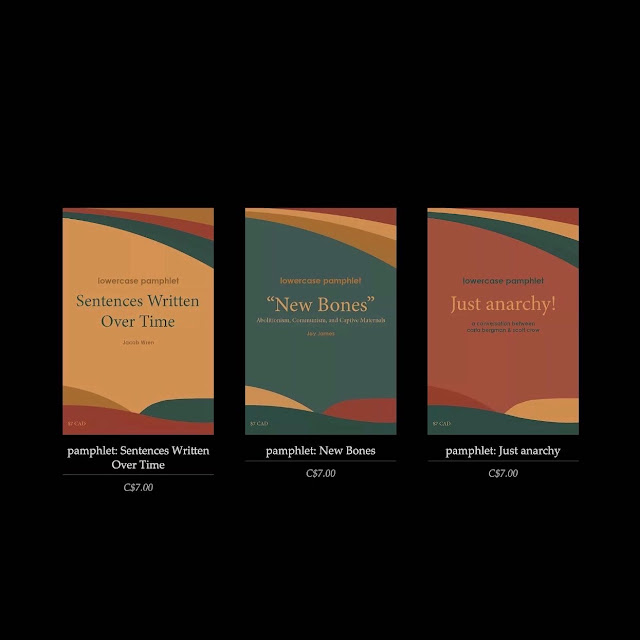
I am happy to have my work be one of the first three lowercase pamphlets:
Sentences Written Over Time by Jacob Wren
New Bones: Abolitionism, Communism, and Captive Maternals by Joy James
Just anarchy: a conversation between carla joy bergman and scott crow
*
lowercase pamphlets (so far) are curated by carla bergman and chris time steele
Graphics and layout design by Maia Anstey and carla bergman, with support by Jamie Leigh Gonzales, and printed by Listening House Media.
lowercase pamphlets range in scope and topics, but are rooted in amplifying kinetic ideas. A common thread throughout the series is the writers are sure to inspire.
Themes from forthcoming pamphlets include, abolition, colonial time, autonomy, feminisms, madness, anarchy, and much more.
The pamphlets in their unique ways share stories of justice and freedom for all. Plus the pamphlets look cool.
Why pamphlets? Because we’re trying to find each other outside of the algorithms that seek to divide us. We think pamphlets are sometimes the perfect size for hashing out an idea in an accessible and fun way.

.
I am happy to have my work be one of the first three lowercase pamphlets:
Sentences Written Over Time by Jacob Wren
New Bones: Abolitionism, Communism, and Captive Maternals by Joy James
Just anarchy: a conversation between carla joy bergman and scott crow
*
lowercase pamphlets (so far) are curated by carla bergman and chris time steele
Graphics and layout design by Maia Anstey and carla bergman, with support by Jamie Leigh Gonzales, and printed by Listening House Media.
lowercase pamphlets range in scope and topics, but are rooted in amplifying kinetic ideas. A common thread throughout the series is the writers are sure to inspire.
Themes from forthcoming pamphlets include, abolition, colonial time, autonomy, feminisms, madness, anarchy, and much more.
The pamphlets in their unique ways share stories of justice and freedom for all. Plus the pamphlets look cool.
Why pamphlets? Because we’re trying to find each other outside of the algorithms that seek to divide us. We think pamphlets are sometimes the perfect size for hashing out an idea in an accessible and fun way.
.
February 6, 2022
MACHO INTELECTUAL by INVASORIX
I studied with a macho-macho-man
He was a very popular teacher
HE WAS AN INTELLECTUAL MACHO
HE WAS AN INTELLECTUAL MACHO
He impressed with his subjectivity
and everybody wanted to listen to him
DON’T PLAY DUMB
HE WAS AN INTELLECTUAL MACHO
He spoke to me about Foucault,
about discipline and punishment
And he just wanted to shut me up
to fuck me up and fuck me, to educate and dominate me,
to annoy and humiliate me, to bend me over and break me
to impress, flirt, outshine, confuse me
lecture me, bluff and indoctrinate me
He spoke to me about Ranciere, too.
I worked with a macho-macho-man
He was a cool guy
HE WAS AN INTELLECTUAL MACHO
HE WAS AN INTELLECTUAL MACHO
He spoke to me about struggle and self-determination
about anarchy and polyamory
DON’T PLAY DUMB
HE WAS AN INTELLECTUAL MACHO
You never stop talking
You never listen
and you only seek to stand out
HE WAS A PROGRESSIVE,
GESTURAL, RELATIONAL, GLOBAL-LOCAL,
MEDIEVAL, ENIRONMENTAL, HEDONIST,
ACTIVIST-ELITIST, VIRTUAL, CONCEPTUAL,
SPIRITUAL, INTERNATIONAL ARTIST
SITUATIONIST
I came across a macho-girl
She was a potential sister
SHE WAS AN INTELLECTUAL MACHO
SHE WAS AN INTELLECTUAL MACHO
We mistook fraternity
for ambition and competition
HERE, WHO IS, HERE, WHO IS THE INTELLECTUAL MACHO
We are sick of competing,
of self-sabotaging
of abuses of power
I don’t sell myself, I don’t exploit myself, I don’t let myself get fooled
Don’t hide, don’t pretend, don’t let yourself be censored
I don’t sell myself, I don’t exploit myself, I don’t let myself get fooled
Don’t hide, don’t pretend, don’t let yourself be censored
[You can find more INVASORIX here: https://invasorix.tumblr.com]
.
January 17, 2022
Hey! Listen to me! I'm on the stereo!
.
Thanks so much to Nantali Indongo and CBC's The Bridge for having me on air the other day.
We talked about Cheap Trick, Beverly Glenn-Copeland, PME-ART, Vulnerable Paradoxes, Every Song I've Ever Written, Zoom meetings, being on tour, my Instagram, child star syndrome and so much more.
[As well, if you want to check out Momus covering the songs I wrote when I was a teenager you can find the playlist here.]
[And if the title of this post doesn't mean anything to you, you might want to listen to this.]
.
Thanks so much to Nantali Indongo and CBC's The Bridge for having me on air the other day.
We talked about Cheap Trick, Beverly Glenn-Copeland, PME-ART, Vulnerable Paradoxes, Every Song I've Ever Written, Zoom meetings, being on tour, my Instagram, child star syndrome and so much more.
[As well, if you want to check out Momus covering the songs I wrote when I was a teenager you can find the playlist here.]
[And if the title of this post doesn't mean anything to you, you might want to listen to this.]
.
January 13, 2022
My column in The Society for the Diffusion of Useful Knowledge
.
I was happy to have a column in SDUK (The Society for the Diffusion of Useful Knowledge) published by The Blackwood Gallery. These are the three instalments:
The First Chapter
In Support of the Censure
In Spite of Defeatism
.
I was happy to have a column in SDUK (The Society for the Diffusion of Useful Knowledge) published by The Blackwood Gallery. These are the three instalments:
The First Chapter
In Support of the Censure
In Spite of Defeatism
.
January 8, 2022
Two short passages from Hospitality Matters: Un entretien avec PME-ART
.
I have such a strong belief in collaboration: as something thematically essential, as a place to make artistic breakthroughs that are simply impossible to make on one’s own, as a way to attempt to break our culture’s (and art’s) incredible over-emphasis on individualism and the individual artist, as a way to be a little bit less alone in the world. At the same time, I generally find the actual lived experience of collaboration to be incredibly difficult. Perhaps psychologically I’m not really made for it. I guess there’s a lot of tension in this paradox, and some of that tension must be what energizes the work. As I was writing this, a strange sentence suddenly popped into my head: the work of PME-ART is both too collaborative and not collaborative enough. There is something off-kilter about our way of collaborating with others, and out of this something I believe a different kind of performance might emerge.
*
Yes, I like that way of putting it, our “performances are also about escaping performance,” but I think for me this is almost true of everything that has value, that it somehow needs to attempt to transcend previous conceptions of what it might be or become. I believe somewhere Alain Badiou says philosophy must also embrace anti-philosophy, and that has something to do with my approach as well: performance must also embrace anti-performance, and also embrace everything else as well, everything that’s outside of performance, so much of life that most performance so casually ignores. I want something unexpected to happen, to be surprised, and to surprise myself.
“Finding ways to make performances incapable” is also a formulation I’m very much attracted to. I think, for me, this also has something to do with life: I don’t feel I’m able to live and yet I somehow continue to live anyway. Sometimes I say that I’m good at art, bad at life. And this feeling forces me to live my struggles with life within art, within performance. So the performance can never feel okay, there is so much conflict, difficulty, ambiguity, uncertainty in my relations towards it, and in the act of performing it in public, in front of people who might very well find life so much easier than I do. On the other hand, perhaps many of them find it just as difficult. Performance (or whatever we wish to call it) might be one of the places where we can find out.
You can read the full interview here: Hospitality Matters: Un entretien avec PME-ART
.
I have such a strong belief in collaboration: as something thematically essential, as a place to make artistic breakthroughs that are simply impossible to make on one’s own, as a way to attempt to break our culture’s (and art’s) incredible over-emphasis on individualism and the individual artist, as a way to be a little bit less alone in the world. At the same time, I generally find the actual lived experience of collaboration to be incredibly difficult. Perhaps psychologically I’m not really made for it. I guess there’s a lot of tension in this paradox, and some of that tension must be what energizes the work. As I was writing this, a strange sentence suddenly popped into my head: the work of PME-ART is both too collaborative and not collaborative enough. There is something off-kilter about our way of collaborating with others, and out of this something I believe a different kind of performance might emerge.
*
Yes, I like that way of putting it, our “performances are also about escaping performance,” but I think for me this is almost true of everything that has value, that it somehow needs to attempt to transcend previous conceptions of what it might be or become. I believe somewhere Alain Badiou says philosophy must also embrace anti-philosophy, and that has something to do with my approach as well: performance must also embrace anti-performance, and also embrace everything else as well, everything that’s outside of performance, so much of life that most performance so casually ignores. I want something unexpected to happen, to be surprised, and to surprise myself.
“Finding ways to make performances incapable” is also a formulation I’m very much attracted to. I think, for me, this also has something to do with life: I don’t feel I’m able to live and yet I somehow continue to live anyway. Sometimes I say that I’m good at art, bad at life. And this feeling forces me to live my struggles with life within art, within performance. So the performance can never feel okay, there is so much conflict, difficulty, ambiguity, uncertainty in my relations towards it, and in the act of performing it in public, in front of people who might very well find life so much easier than I do. On the other hand, perhaps many of them find it just as difficult. Performance (or whatever we wish to call it) might be one of the places where we can find out.
You can read the full interview here: Hospitality Matters: Un entretien avec PME-ART
.
December 18, 2021
Some passages from We Do This 'Til We Free Us by Mariame Kaba
Some passages from We Do This 'Til We Free Us: Abolitionist Organizing and Transforming Justice by Mariame Kaba:
*
“So, maybe I just have a different perspective and I talk to a lot of young organizers - people reach out to me a lot because I’ve been organizing for a long time - I’m always telling them, “Your timeline is not the timeline on which movements occur. Your timeline is incidental. Your timeline is only for yourself to mark your growth and your living.” But that’s a fraction of the living that’s going to be done by the universe and that has already been done by the universe. So, when you understand that you’re really insignificant in the grand scheme of things, you just are, then it’s a freedom, in my opinion, to actually be able to do the work that’s necessary as you see it and to contribute in the ways that you can see fit. So, I think that’s my answer to that.
And self-care is really tricky for me, because I don’t believe in the self in the way that people determine it here in this capitalist society that we live in. I don’t believe in self-care, I believe in collective care, collectivizing our care, and thinking more about how we can help each other. How can we collectivize the care of children so that more people can feel like they can actually have their kids but also live in the world and contribute and participate in various different kinds of ways? How do we do that? How do we collectivize care so that when we’re sick and we’re not feeling ourselves, we’ve got a crew of people that are not just our prayer warriors, but our action warriors who are thinking through with us? Like, I’m not just going to be able to cook this week, and you have a whole bunch of folks there, who are just putting a list together for you and bringing the food every day that week and you’re doing the same for your community, too.
I want that as the focus of how I do things and that really comes from the fact that I grew up the daughter of returned migrants, African-returned migrants. I don’t see the world the way that people do here, I just don’t. I don’t agree with it, I think capitalism is actually continuously alienating us from each other, but also even from ourselves and I just don’t subscribe. And for me, it’s too much with, “Yeah I’m going to go do yoga and then, I’m going to go and do some sit-ups and maybe I’ll like, you know, go to…” You don’t have to go anywhere to care for yourself.
You can just care for yourself and your community in tandem and that can actually be much more healthy for you, by the way. Because all this internalized, internal reflection is not good for people. You have to be able to have… Yes, think about yourself, reflect on your practice, okay, but then you need to test it in the world, you’ve got to be with people. So, that’s important. And I hate people! So, I say that as somebody who actually is really anti-social… I don’t want to socialize in that kind of way but I do want to be social with other folks as it relates to collectivizing care.”
*
“You can’t force somebody into being accountable for things they do. That is not possible. People have to take accountability for things that they actually do wrong. They have to decide that this is wrong. They have to say, “This is wrong and I want to be part of making some sort of amends or repairing this or not doing it again.” The question is: What in our culture allows people to do that? What are the structural things that exist? What in our culture encourages people who assault people and harm people to take responsibility? What I see is almost nothing.”
*
“Not only is it true that punishment doesn’t work, but also when you prioritize punishment it means that patriarchy remains firmly in place. And if I am at my core interested in dismantling systems of oppression, I have got to get rid of punishment. I have got to do it. But I want accountability. I want people to take responsibility. I want that internal resource that allows you to take responsibility for harms that you commit against yourself and other people. I want that to be a central part of how we interact with each other. Because while I don’t believe in punishment, I believe in consequences for actions that are done to harm other people. I do. I think boundaries are important. I think all these things are really important. But with punishment at the centre of everything we haven’t been able to really address the other stuff that needs to happen. Because people fucking need to – they need to take accountability when they harm people.”
*
“Oh my gosh. You’re asking me great hard questions. I keep threatening to write an essay called “Abolition Is Not About Your Fucking Feelings.” I wrote that in a tweet and got so much blowback because people felt like I was insulting their ability to feel what they want to feel. That’s really not what I’m saying. The concept of the personal being political as a basis for feminist organizing in the past is so true, and yet it is so fraught at the same time. What it’s not saying – and I think what sometimes people want it to be saying – is that how I personally feel then should be made into policy. And we can’t operate in a world where that’s true. We shouldn’t codify our personal feelings of vengeance to apply to the entire world.”
*
“Also, I really feel like over the years I’ve learned myself better. And that helps you to figure out what your actual boundaries are. And also, boundaries are usually a negotiation between what you want and what other people want. It’s not like a firm, set thing. You have to get really good at being able to negotiate. And the only way to do that is to know who you are.”
*
“It’s like, why? You’re going to burn out. It’s not humanly possible for you to just be your Lone Ranger self out there in the world. Ella Baker’s question “Who are your people?” when she would meet you is so important. Who are you accountable to in this world? Because that will tell me a lot about who you are.
And how much hubris must we have to think that we, as individuals, will have all the answers for generations’ worth of harm built by millions and millions of people? It’s like I’m on a five-hundred-year clock right now. I’m right here knowing that we’ve got a hell of a long time before we’re going to see the end. Right now, all we’re doing as organizers is creating the conditions that will allow our collective vision to take hold and grow.”
.
*
“So, maybe I just have a different perspective and I talk to a lot of young organizers - people reach out to me a lot because I’ve been organizing for a long time - I’m always telling them, “Your timeline is not the timeline on which movements occur. Your timeline is incidental. Your timeline is only for yourself to mark your growth and your living.” But that’s a fraction of the living that’s going to be done by the universe and that has already been done by the universe. So, when you understand that you’re really insignificant in the grand scheme of things, you just are, then it’s a freedom, in my opinion, to actually be able to do the work that’s necessary as you see it and to contribute in the ways that you can see fit. So, I think that’s my answer to that.
And self-care is really tricky for me, because I don’t believe in the self in the way that people determine it here in this capitalist society that we live in. I don’t believe in self-care, I believe in collective care, collectivizing our care, and thinking more about how we can help each other. How can we collectivize the care of children so that more people can feel like they can actually have their kids but also live in the world and contribute and participate in various different kinds of ways? How do we do that? How do we collectivize care so that when we’re sick and we’re not feeling ourselves, we’ve got a crew of people that are not just our prayer warriors, but our action warriors who are thinking through with us? Like, I’m not just going to be able to cook this week, and you have a whole bunch of folks there, who are just putting a list together for you and bringing the food every day that week and you’re doing the same for your community, too.
I want that as the focus of how I do things and that really comes from the fact that I grew up the daughter of returned migrants, African-returned migrants. I don’t see the world the way that people do here, I just don’t. I don’t agree with it, I think capitalism is actually continuously alienating us from each other, but also even from ourselves and I just don’t subscribe. And for me, it’s too much with, “Yeah I’m going to go do yoga and then, I’m going to go and do some sit-ups and maybe I’ll like, you know, go to…” You don’t have to go anywhere to care for yourself.
You can just care for yourself and your community in tandem and that can actually be much more healthy for you, by the way. Because all this internalized, internal reflection is not good for people. You have to be able to have… Yes, think about yourself, reflect on your practice, okay, but then you need to test it in the world, you’ve got to be with people. So, that’s important. And I hate people! So, I say that as somebody who actually is really anti-social… I don’t want to socialize in that kind of way but I do want to be social with other folks as it relates to collectivizing care.”
*
“You can’t force somebody into being accountable for things they do. That is not possible. People have to take accountability for things that they actually do wrong. They have to decide that this is wrong. They have to say, “This is wrong and I want to be part of making some sort of amends or repairing this or not doing it again.” The question is: What in our culture allows people to do that? What are the structural things that exist? What in our culture encourages people who assault people and harm people to take responsibility? What I see is almost nothing.”
*
“Not only is it true that punishment doesn’t work, but also when you prioritize punishment it means that patriarchy remains firmly in place. And if I am at my core interested in dismantling systems of oppression, I have got to get rid of punishment. I have got to do it. But I want accountability. I want people to take responsibility. I want that internal resource that allows you to take responsibility for harms that you commit against yourself and other people. I want that to be a central part of how we interact with each other. Because while I don’t believe in punishment, I believe in consequences for actions that are done to harm other people. I do. I think boundaries are important. I think all these things are really important. But with punishment at the centre of everything we haven’t been able to really address the other stuff that needs to happen. Because people fucking need to – they need to take accountability when they harm people.”
*
“Oh my gosh. You’re asking me great hard questions. I keep threatening to write an essay called “Abolition Is Not About Your Fucking Feelings.” I wrote that in a tweet and got so much blowback because people felt like I was insulting their ability to feel what they want to feel. That’s really not what I’m saying. The concept of the personal being political as a basis for feminist organizing in the past is so true, and yet it is so fraught at the same time. What it’s not saying – and I think what sometimes people want it to be saying – is that how I personally feel then should be made into policy. And we can’t operate in a world where that’s true. We shouldn’t codify our personal feelings of vengeance to apply to the entire world.”
*
“Also, I really feel like over the years I’ve learned myself better. And that helps you to figure out what your actual boundaries are. And also, boundaries are usually a negotiation between what you want and what other people want. It’s not like a firm, set thing. You have to get really good at being able to negotiate. And the only way to do that is to know who you are.”
*
“It’s like, why? You’re going to burn out. It’s not humanly possible for you to just be your Lone Ranger self out there in the world. Ella Baker’s question “Who are your people?” when she would meet you is so important. Who are you accountable to in this world? Because that will tell me a lot about who you are.
And how much hubris must we have to think that we, as individuals, will have all the answers for generations’ worth of harm built by millions and millions of people? It’s like I’m on a five-hundred-year clock right now. I’m right here knowing that we’ve got a hell of a long time before we’re going to see the end. Right now, all we’re doing as organizers is creating the conditions that will allow our collective vision to take hold and grow.”
.
December 14, 2021
Idea/Process
.
[This text was originally published as part of the free book F A N Z I N E L E V E L 2 0 / 2 1.]
No one really knows how it works. Is there an idea? In the grant applications you of course must at least pretend there’s an idea. An idea that will be developed throughout the course of a process. What actually happens throughout the course of this process? Things are attempted, some are accepted, others rejected. The criteria for such acceptance or rejection appears to be ever-shifting. Criteria as some sort of feeling. A difficult to pin down feeling. Almost like a pain. I feel this thing should be part of the idea we are working on, while I feel this other thing perhaps should not. Or is it the other way round? The more things that become part of it, the less newer things seem to fit. At the beginning, when there is nothing, almost anything might fit. While near the end, when there are many things, almost nothing will. It is not a puzzle, because the various pieces haven’t been cut into shapes, and therefore there is no pre-decided way they may or may not fit together. The pieces will never, in fact, really fit together. That is the works charm. Also that it is charmless. And that we made it. We made it together and only we know how. And we don’t even know how. We can go back to the grant application and look at the original idea and wonder how we got from there to here. The audience cannot see the process but we want the audience to see the process. At least some shadow or taste or hint of it. The decisions and ever-shifting criteria and internal disagreements that brought us all the way to this fragile point. The point at which our process meets its end in the form of potential judgement. The point when our friends from the audience perhaps don’t quite know what to say. Would it all be better if we had started from a better idea?
.
[This text was originally published as part of the free book F A N Z I N E L E V E L 2 0 / 2 1.]
No one really knows how it works. Is there an idea? In the grant applications you of course must at least pretend there’s an idea. An idea that will be developed throughout the course of a process. What actually happens throughout the course of this process? Things are attempted, some are accepted, others rejected. The criteria for such acceptance or rejection appears to be ever-shifting. Criteria as some sort of feeling. A difficult to pin down feeling. Almost like a pain. I feel this thing should be part of the idea we are working on, while I feel this other thing perhaps should not. Or is it the other way round? The more things that become part of it, the less newer things seem to fit. At the beginning, when there is nothing, almost anything might fit. While near the end, when there are many things, almost nothing will. It is not a puzzle, because the various pieces haven’t been cut into shapes, and therefore there is no pre-decided way they may or may not fit together. The pieces will never, in fact, really fit together. That is the works charm. Also that it is charmless. And that we made it. We made it together and only we know how. And we don’t even know how. We can go back to the grant application and look at the original idea and wonder how we got from there to here. The audience cannot see the process but we want the audience to see the process. At least some shadow or taste or hint of it. The decisions and ever-shifting criteria and internal disagreements that brought us all the way to this fragile point. The point at which our process meets its end in the form of potential judgement. The point when our friends from the audience perhaps don’t quite know what to say. Would it all be better if we had started from a better idea?
.
December 8, 2021
Some favourite things from my 2021
.
[So it seems like I now do this list more or less every year. I really do love lists. As with previous years, this is in no particular order and many of these things didn't come out during the previous year. As well, there would normally be some performances and exhibitions, but due to the pandemic I didn't see very many and couldn't quite figure out which ones to include, which is sad.]
Books
LOTE – Shola von Reinhold
We Do This 'Til We Free Us – Mariame Kaba
Believers: Making a Life at the End of the World – Lisa Wells
Pollution Is Colonialism – Max Liboiron
Search History – Eugene Lim
Writing in Space, 1973–2019 – Lorraine O’Grady
Incognegro – Frank B. Wilderson III
The True Deceiver – Tove Jansson
We, Jane – Aimee Wall
The Freezer Door – Mattilda Bernstein Sycamore
The Sunflower Cast a Spell To Save Us From The Void – Jackie Wang
The Actual Star – Monica Byrne
Eladatl – Sesshu Foster & Arturo Ernesto Romo
Insurrecto – Gina Apostol
The Secret Service – Wendy Walker
Music
Mega Bog – Life, and Another
Pino Palladino / Blake Mills – Notes With Attachments
Chicago Underground Quartet – Good Days
L’Rain – Fatigue
Ben LaMar Gay – Open Arms to Open Us
Eddie Chacon – Pleasure, Joy and Happiness
Wau Wau Collectif – Yaral Sa Doom
Peter Ivers – Becoming Peter Ivers
Gilles Poizat – Horse in the House
Tiziano Popoli – Burn the Night
Virginia Wing – Ecstatic Arrow
Fievel Is Glauque – God’s Trashmen Sent to Right the Mess
Bruiser Wolf – Dope Game Stupid
caroline – Skydiving onto the library roof
Bilal Salaam - Swordlord: Swordz II Zakat
Plus:
Some passages from Writing in Space, 1973–2019 by Lorraine O’Grady
Some passages from Believers: Making a Life at the End of the World by Lisa Wells
Some passages from We Do This 'Til We Free Us: Abolitionist Organizing and Transforming Justice by Mariame Kaba
.
[So it seems like I now do this list more or less every year. I really do love lists. As with previous years, this is in no particular order and many of these things didn't come out during the previous year. As well, there would normally be some performances and exhibitions, but due to the pandemic I didn't see very many and couldn't quite figure out which ones to include, which is sad.]
Books
LOTE – Shola von Reinhold
We Do This 'Til We Free Us – Mariame Kaba
Believers: Making a Life at the End of the World – Lisa Wells
Pollution Is Colonialism – Max Liboiron
Search History – Eugene Lim
Writing in Space, 1973–2019 – Lorraine O’Grady
Incognegro – Frank B. Wilderson III
The True Deceiver – Tove Jansson
We, Jane – Aimee Wall
The Freezer Door – Mattilda Bernstein Sycamore
The Sunflower Cast a Spell To Save Us From The Void – Jackie Wang
The Actual Star – Monica Byrne
Eladatl – Sesshu Foster & Arturo Ernesto Romo
Insurrecto – Gina Apostol
The Secret Service – Wendy Walker
Music
Mega Bog – Life, and Another
Pino Palladino / Blake Mills – Notes With Attachments
Chicago Underground Quartet – Good Days
L’Rain – Fatigue
Ben LaMar Gay – Open Arms to Open Us
Eddie Chacon – Pleasure, Joy and Happiness
Wau Wau Collectif – Yaral Sa Doom
Peter Ivers – Becoming Peter Ivers
Gilles Poizat – Horse in the House
Tiziano Popoli – Burn the Night
Virginia Wing – Ecstatic Arrow
Fievel Is Glauque – God’s Trashmen Sent to Right the Mess
Bruiser Wolf – Dope Game Stupid
caroline – Skydiving onto the library roof
Bilal Salaam - Swordlord: Swordz II Zakat
Plus:
Some passages from Writing in Space, 1973–2019 by Lorraine O’Grady
Some passages from Believers: Making a Life at the End of the World by Lisa Wells
Some passages from We Do This 'Til We Free Us: Abolitionist Organizing and Transforming Justice by Mariame Kaba
.
December 1, 2021
Some lines from the first two volumes of Susan Sontag's diaries
.
From Reborn: Journals and Notebooks, 1947-1963
“I am not myself with people […] but am I myself when alone? That seems unlikely, too.”
*
“The world is cluttered with dead institutions.”
*
“Life is suicide, mediated.”
*
“There is often a contradiction between the meaning of our actions toward a person and what we say we feel toward that person in a journal. But this does not mean that what we do is shallow, and only what we confess to ourselves is deep. Confessions, I mean sincere confessions of course, can be more shallow than actions. I am thinking now of what I read today (when I went up to 122 Boulevard Saint-Germain to check for her mail) in Harriet’s journal about me – that curt, unfair, uncharitable assessment of me which concluded by her saying that she really doesn’t like me but my passion for her is acceptable and opportune. God knows it hurts, and I feel indignant and humiliated. We rarely do know what people think of us (or, rather, think they think of us)… Do I feel guilty about reading what was not intended for my eyes? No. One of the main (social) functions of a journal or diary is precisely to be read furtively by other people, the people (like parents + lovers) about whom one has been cruelly honest only in the journal. Will Harriet ever read this?”
*
“Harriet said something very striking yesterday, apropos of Sam W.’s enormous library, that collecting books in that way was “like marrying someone in order to sleep with him.”
True…
Use libraries!!”
*
“Inspiration presents itself to me in the form of anxiety.”
*
“I told her tonight she is always putting me in the position of saying “I’m sorry.”
She told me to go read a sex manual.”
*
From As Consciousness is Harnessed to Flesh: Journals and Notebooks, 1964-1980
“A miracle is just an accident, with fancy trappings.”
*
“One man thinks before he acts. Another man thinks after he acts. Each is of the opinion that the other thinks too much.”
*
“If I can’t bring judgement against the world, I must bring it against myself.
I’m learning to bring judgement against the world.”
*
“Every act is a compromise (between what one wants + what one thinks is possible.)”
*
“Ivan searching for a reply to something I said: “Wait… I can taste it but I can’t yet find the words.””
*
“I suspect now that lusting after the good isn’t what a really good person does.”
*
“Thoreau on his death bed – on being asked what were his feelings about the next world: “One world at a time.””
*
“The extraordinary frequency with which the plot of a serious contemporary novel turns on, or resolves itself, by a murder – compared with the extreme unlikelihood that the educated writers of vanguard fiction have ever been anywhere near a murder in their lives.”
.
From Reborn: Journals and Notebooks, 1947-1963
“I am not myself with people […] but am I myself when alone? That seems unlikely, too.”
*
“The world is cluttered with dead institutions.”
*
“Life is suicide, mediated.”
*
“There is often a contradiction between the meaning of our actions toward a person and what we say we feel toward that person in a journal. But this does not mean that what we do is shallow, and only what we confess to ourselves is deep. Confessions, I mean sincere confessions of course, can be more shallow than actions. I am thinking now of what I read today (when I went up to 122 Boulevard Saint-Germain to check for her mail) in Harriet’s journal about me – that curt, unfair, uncharitable assessment of me which concluded by her saying that she really doesn’t like me but my passion for her is acceptable and opportune. God knows it hurts, and I feel indignant and humiliated. We rarely do know what people think of us (or, rather, think they think of us)… Do I feel guilty about reading what was not intended for my eyes? No. One of the main (social) functions of a journal or diary is precisely to be read furtively by other people, the people (like parents + lovers) about whom one has been cruelly honest only in the journal. Will Harriet ever read this?”
*
“Harriet said something very striking yesterday, apropos of Sam W.’s enormous library, that collecting books in that way was “like marrying someone in order to sleep with him.”
True…
Use libraries!!”
*
“Inspiration presents itself to me in the form of anxiety.”
*
“I told her tonight she is always putting me in the position of saying “I’m sorry.”
She told me to go read a sex manual.”
*
From As Consciousness is Harnessed to Flesh: Journals and Notebooks, 1964-1980
“A miracle is just an accident, with fancy trappings.”
*
“One man thinks before he acts. Another man thinks after he acts. Each is of the opinion that the other thinks too much.”
*
“If I can’t bring judgement against the world, I must bring it against myself.
I’m learning to bring judgement against the world.”
*
“Every act is a compromise (between what one wants + what one thinks is possible.)”
*
“Ivan searching for a reply to something I said: “Wait… I can taste it but I can’t yet find the words.””
*
“I suspect now that lusting after the good isn’t what a really good person does.”
*
“Thoreau on his death bed – on being asked what were his feelings about the next world: “One world at a time.””
*
“The extraordinary frequency with which the plot of a serious contemporary novel turns on, or resolves itself, by a murder – compared with the extreme unlikelihood that the educated writers of vanguard fiction have ever been anywhere near a murder in their lives.”
.
November 18, 2021
Marco Roth on Sylvère Lotringer
.
What I’m trying to say about Sylvère was that he attracted and maintained an aura of possibility, and that this allowed me to begin to be myself in a way that I’d never imagined I could be. He didn’t care if I was his best student that year, or if I went to graduate school, or if I became a habitué of whatever was then left of the downtown arts world. It was an education in indiscipline, or liberation, which, if taken seriously, also became a kind of discipline. In other words, Sylvère offered his students exactly what he also, as an interviewer, interlocutor, and then publisher, offered philosophers like Paul Virilio, Black Panther activists, S&M performance artists, and eventually writers such as Kathy Acker and Chris Kraus: the opportunity to further articulate and refine a liberating or liberationist practice, sometimes in the form of resistance, sometimes in creation, or in the synthesis of the two. This was a kind of dignity most of us were unused to being treated with.
What his colleagues and his critics, and possibly many of his students, never could forgive him for was that he made it too easy to take advantage of his largesse—everyone pretty much got an A, and the arbitrary focus of the massive syllabi and his penchant to digress made it easy not to do the reading. He was treated like a mad uncle or a clown. But to use Sylvère to game the system was our failing, not his. Sylvère allowed himself to be exploited, but that was also his way of offering a reproach, against us, against the university, also against himself. “It’s so easy to be a masochist,” he said once, in the Proust class, “almost everyone is. To be a sadist requires hard work.”
Total freedom is also a total ethical demand. If you took Sylvère seriously, as I did, he could make you feel incredibly guilty. And many refused to take him seriously just to avoid feeling that way. There’s a moment in Chris Kraus’s novel Torpor that captures the more intimate and more intense form that guilt could take on in a couple: “Sylvie knew her fate would be linked forever to Jerome’s unhappiness, and so she longed to simply make it disappear,” she writes, “As if she could make it go away through will, or empathy—some act of magical transference. But to think that was as grandiose and futile as believing she could travel back in time and stop the Nazi troops from marching into Austria or invading Paris.”
The unhappiness Kraus writes of is that of Sylvere’s childhood, lost to the war, the years of hiding and deprivation when he was scarcely more than a toddler. That trauma—always beneath the beach beneath the street—was incurable, for him, as for so many who “survived.” But as his student, one sensed that he wanted to give to others that ultimate possibility—not of making unhappiness “disappear,” not of exiting history, but of making it less determinative—that he could not find for himself despite all his playfulness and experimentation.
- Marco Roth, On Sylvère Lotringer (1938–2021)
.
What I’m trying to say about Sylvère was that he attracted and maintained an aura of possibility, and that this allowed me to begin to be myself in a way that I’d never imagined I could be. He didn’t care if I was his best student that year, or if I went to graduate school, or if I became a habitué of whatever was then left of the downtown arts world. It was an education in indiscipline, or liberation, which, if taken seriously, also became a kind of discipline. In other words, Sylvère offered his students exactly what he also, as an interviewer, interlocutor, and then publisher, offered philosophers like Paul Virilio, Black Panther activists, S&M performance artists, and eventually writers such as Kathy Acker and Chris Kraus: the opportunity to further articulate and refine a liberating or liberationist practice, sometimes in the form of resistance, sometimes in creation, or in the synthesis of the two. This was a kind of dignity most of us were unused to being treated with.
What his colleagues and his critics, and possibly many of his students, never could forgive him for was that he made it too easy to take advantage of his largesse—everyone pretty much got an A, and the arbitrary focus of the massive syllabi and his penchant to digress made it easy not to do the reading. He was treated like a mad uncle or a clown. But to use Sylvère to game the system was our failing, not his. Sylvère allowed himself to be exploited, but that was also his way of offering a reproach, against us, against the university, also against himself. “It’s so easy to be a masochist,” he said once, in the Proust class, “almost everyone is. To be a sadist requires hard work.”
Total freedom is also a total ethical demand. If you took Sylvère seriously, as I did, he could make you feel incredibly guilty. And many refused to take him seriously just to avoid feeling that way. There’s a moment in Chris Kraus’s novel Torpor that captures the more intimate and more intense form that guilt could take on in a couple: “Sylvie knew her fate would be linked forever to Jerome’s unhappiness, and so she longed to simply make it disappear,” she writes, “As if she could make it go away through will, or empathy—some act of magical transference. But to think that was as grandiose and futile as believing she could travel back in time and stop the Nazi troops from marching into Austria or invading Paris.”
The unhappiness Kraus writes of is that of Sylvere’s childhood, lost to the war, the years of hiding and deprivation when he was scarcely more than a toddler. That trauma—always beneath the beach beneath the street—was incurable, for him, as for so many who “survived.” But as his student, one sensed that he wanted to give to others that ultimate possibility—not of making unhappiness “disappear,” not of exiting history, but of making it less determinative—that he could not find for himself despite all his playfulness and experimentation.
- Marco Roth, On Sylvère Lotringer (1938–2021)
.
October 28, 2021
Four passages from Authenticity is a Feeling
Four passages from Authenticity is a Feeling: My Life in PME-ART by Jacob Wren:
*
There are no individual solutions to collective problems. Nonetheless, it is individuals who must come together and figure out what to do. In all of this, there is the unaddressed question of leadership. The anarchist in me genuinely believes rotating leadership is a solution: people take turns taking the lead in the areas of their greatest competence, interest, or desire. Another similar collaborative idea might be: best idea wins. But art is so subjective, and for five different people five different ideas might each seem best. It has always been my thinking that if someone in the group feels strongly that we should do something, then we should do it, their strong desire shouldn’t be watered or sanded down by the democratic entropy of the group. I want the projects to be open enough to welcome the strongest impulses of each of the participants. This is my ideal, and like all ideals it is something I often fall short of achieving. Perhaps this ideal is not even best for every collaborative situation. In a sense, it is just another way of saying that I want to work in ways that are deeply collaborative while at the same time keeping our most intense individual artistic differences more alive than alive.
*
I went to the theatre and what I saw hinted at my desires but mainly felt like their frustrating opposite. If in conventional theatre you had costumes, characters, acting, scripted narrative, piped-in music, and artifice, instead I wanted people dressed in their normal clothing, being themselves, walking a tightrope between structure and spontaneity, music we loved played on vinyl, CDs, or with instruments, anything and everything that might bring us just a little bit closer to authenticity or reality. There was a kind of theatre that already existed and a kind of theatre that didn’t yet exist, might never exist, and I knew which side I was on.
*
I often say I don’t necessarily relate to people who make art, performance, or literature, but I do relate to people who make art, performance, and literature who think of quitting every fifteen seconds. Those are really my people. I call us the boy-who-cried-wolf set, since we always announce we’re quitting but never do, and therefore no one believes us anymore. It seems to me that anyone who works in the arts today and doesn’t have serious, ongoing doubts as to the validity or efficacy of the situation is not facing all of the current, inherent problems and questions with open eyes.
*
Not as much now, but more when we first met, Sylvie would sometimes talk about the power of being the official opposition in theatre or in art. That the official opposition can sometimes do more to change things, both more to change the discourse and more to change concrete policies and actions, than those actually in power. The official opposition has the freedom to push as hard as they want, to act purely on principle, and by continually doing so they can keep things moving toward change.
*
[These quotes can also be found translated into French here.]
[And feel free to check out the PME-ART website here.]
.
*
There are no individual solutions to collective problems. Nonetheless, it is individuals who must come together and figure out what to do. In all of this, there is the unaddressed question of leadership. The anarchist in me genuinely believes rotating leadership is a solution: people take turns taking the lead in the areas of their greatest competence, interest, or desire. Another similar collaborative idea might be: best idea wins. But art is so subjective, and for five different people five different ideas might each seem best. It has always been my thinking that if someone in the group feels strongly that we should do something, then we should do it, their strong desire shouldn’t be watered or sanded down by the democratic entropy of the group. I want the projects to be open enough to welcome the strongest impulses of each of the participants. This is my ideal, and like all ideals it is something I often fall short of achieving. Perhaps this ideal is not even best for every collaborative situation. In a sense, it is just another way of saying that I want to work in ways that are deeply collaborative while at the same time keeping our most intense individual artistic differences more alive than alive.
*
I went to the theatre and what I saw hinted at my desires but mainly felt like their frustrating opposite. If in conventional theatre you had costumes, characters, acting, scripted narrative, piped-in music, and artifice, instead I wanted people dressed in their normal clothing, being themselves, walking a tightrope between structure and spontaneity, music we loved played on vinyl, CDs, or with instruments, anything and everything that might bring us just a little bit closer to authenticity or reality. There was a kind of theatre that already existed and a kind of theatre that didn’t yet exist, might never exist, and I knew which side I was on.
*
I often say I don’t necessarily relate to people who make art, performance, or literature, but I do relate to people who make art, performance, and literature who think of quitting every fifteen seconds. Those are really my people. I call us the boy-who-cried-wolf set, since we always announce we’re quitting but never do, and therefore no one believes us anymore. It seems to me that anyone who works in the arts today and doesn’t have serious, ongoing doubts as to the validity or efficacy of the situation is not facing all of the current, inherent problems and questions with open eyes.
*
Not as much now, but more when we first met, Sylvie would sometimes talk about the power of being the official opposition in theatre or in art. That the official opposition can sometimes do more to change things, both more to change the discourse and more to change concrete policies and actions, than those actually in power. The official opposition has the freedom to push as hard as they want, to act purely on principle, and by continually doing so they can keep things moving toward change.
*
[These quotes can also be found translated into French here.]
[And feel free to check out the PME-ART website here.]
.
September 23, 2021
A few actual dreams from the past eight years
.
In my dream last night, the last thing I remember saying just before I woke up was: ‘Alain Badiou says the most nihilistic song is All You Need Is Love.’
In my dream last night, the name of my band was: This Unstable Honorarium.
Last night in my dream I googled: how do you fight capitalism.
Last night I dreamt I was an arsonist: as I headed to set one last fire, I got a text saying it’s a trap, turned around, and decided to go see art instead.
Last night I dreamt the telescope was invented by aliens, who sent it to us telepathically, to put us on the wrong track.
Last night I dreamt I had writer’s block.
In my dream last night I came to the sudden realization that celebrity culture was the worshipping of false idols.
In my dream last night I read an essay that began: “We’re sick of reading books that are only men writing about their loneliness. We want to read books by women writing about their __________.” But I couldn’t make out the last word. (I had a sense that the last word might be rage.)
In my dream last night my art project was bringing two alligators to different people's houses and then letting the alligators roam free. The project was abruptly brought to an end when one of the alligator's ate someone's baby.
.
In my dream last night, the last thing I remember saying just before I woke up was: ‘Alain Badiou says the most nihilistic song is All You Need Is Love.’
In my dream last night, the name of my band was: This Unstable Honorarium.
Last night in my dream I googled: how do you fight capitalism.
Last night I dreamt I was an arsonist: as I headed to set one last fire, I got a text saying it’s a trap, turned around, and decided to go see art instead.
Last night I dreamt the telescope was invented by aliens, who sent it to us telepathically, to put us on the wrong track.
Last night I dreamt I had writer’s block.
In my dream last night I came to the sudden realization that celebrity culture was the worshipping of false idols.
In my dream last night I read an essay that began: “We’re sick of reading books that are only men writing about their loneliness. We want to read books by women writing about their __________.” But I couldn’t make out the last word. (I had a sense that the last word might be rage.)
In my dream last night my art project was bringing two alligators to different people's houses and then letting the alligators roam free. The project was abruptly brought to an end when one of the alligator's ate someone's baby.
.
September 20, 2021
The institution only cares about the institution
.
If anyone has any ideas, now is the time to try them.
Find them strange, find the difficult strangeness within each one.
We’ve undone what was done, yet it keeps endlessly redoing itself.
(People who are good at art often also have a great deal of difficulty
with many of the other parts of life.)
The aspects of life that make life worth living, how to explain
to myself just exactly what they are.
.
If anyone has any ideas, now is the time to try them.
Find them strange, find the difficult strangeness within each one.
We’ve undone what was done, yet it keeps endlessly redoing itself.
(People who are good at art often also have a great deal of difficulty
with many of the other parts of life.)
The aspects of life that make life worth living, how to explain
to myself just exactly what they are.
.
September 19, 2021
Ecological collapse is well underway...
.
Ecological collapse is well underway
and there is no future to write for
Yet one can still write to pass time
that can no longer be lived as if it were endless
One can still sit doing nothing
knowing climate grief is the grief of our time
the grief of this moment
The moment that knows capitalism
as a project to set fire to the world
a project with a definite end
.
Ecological collapse is well underway
and there is no future to write for
Yet one can still write to pass time
that can no longer be lived as if it were endless
One can still sit doing nothing
knowing climate grief is the grief of our time
the grief of this moment
The moment that knows capitalism
as a project to set fire to the world
a project with a definite end
.
September 8, 2021
I believe it is a common enough experience...
.
I believe it is a common enough experience for a writer to have finished a book and, due to any number of factors, wait a very long time before it sees the light of day. But I've always found it such a strange feeling. Almost as if one's entire being has been put on hold.
.
I believe it is a common enough experience for a writer to have finished a book and, due to any number of factors, wait a very long time before it sees the light of day. But I've always found it such a strange feeling. Almost as if one's entire being has been put on hold.
.
September 5, 2021
An excerpt from The Power Worshippers: Inside the Dangerous Rise of Religious Nationalism by Katherine Stewart
.
Christian academies soon came to depend heavily on public support. In Falwell’s Virginia, for example, state-sponsored tuition grants allowed students to take public money to the school of their choice. As religious entities, moreover, the schools and the organizations running them benefited from significant tax exemption. But in the late 1970s, following a string of court cases, the IRS began to threaten the tax-exempt status of religious groups running race-segregated schools. For conservative religious leaders, the previous decades had seemed like a long string of defeats. And now they had a chief bogeyman in the IRS, which was coming after their schools and their pocketbooks.
It would be hard to overestimate the degree of outrage that the threat of losing their tax-advantaged status on account of their segregationism provoked. As far as leaders like Bob Jones Sr. were concerned, they had a God-given right not just to separate the races but also to receive federal money for this purpose. Emerging leaders of the New Right were prepared to defend them. They began to meet regularly, to discuss politics, and to look for ways to make their voices heard in Washington. Paul Weyrich stoked the flames with sympathetic words about the unjust efforts “to deny them tax-exempt status on the basis of so-called de-facto segregation." In the grievances of the segregationists, he saw the opportunity to found a movement.
The correspondence between the religious conservatives and the New Right conservatives now crackled with energy. At their meetings in Lynchburg, common ground began to emerge. As Harry R. Jackson Jr. and Tony Perkins relate the story in their 2008 book, Personal Faith, Public Policy, “At one point during the wide-ranging discussion, Weyrich is reported to have said that there was a moral majority who wanted to maintain the traditional Christian values that were under assault in America. Falwell asked Weyrich to repeat the statement and then spun around and declared to one of his assistants ‘That’s the name for this organization – the Moral Majority.’” That day, say Jackson and Perkins, “marked the beginning of a new force in the American political landscape… At the rebirth of the Conservative civic involvement in 1979, the new leaders were determined not to repeat the “sins” of the fathers. They would not shy away from controversy, nor would they yield to criticism; they would work with others to restore the moral foundations of the nation.”
But they had a problem. As Weyrich understood, building a new movement around the burning issue of defending the tax advantages of racist schools wasn’t going to be a viable strategy on the national stage. “Stop the tax on segregation” just wasn’t going to inspire the kind of broad-based conservative counterrevolution that Weyrich envisioned. They needed an issue with a more acceptable appeal.
What message would bring the movement together? The men of Lynchburg considered a variety of unifying issues and themes. School prayer worked for some, but it tended to alienate the Catholics, who remembered all too well that, for many years, public schools had allowed only for Protestant prayers and bible readings while excluding Catholic readings and practices. Bashing communists was fine, but even Rockefeller Republicans could do that. Taking on “women’s liberation” was attractive, but the Equal Rights Amendment was already going down in flames. At last they landed on the one surprising word that would supply the key to the political puzzle of the age: “abortion.”
As the historian and author Randall Balmer writes, “It wasn’t until 1979 – a full six years after Roe – that evangelical leaders, at the behest of conservative activist Paul Weyrich, seized on abortion not for moral reasons, but as a rallying-cry to deny President Jimmy Carter a second term. Why? Because the anti-abortion crusade was more palatable than the religious right’s real motive: protecting segregated schools.”
More than a decade later, Weyrich recalled the moment well. At a conference in Washington, D.C., sponsored by a religious right organization called the Ethics and Public Policy Center (to which Balmer had been invited to attend), Weyrich reminded his fellow culture warriors of the facts: “Let us remember, he said animatedly, that the Religious Right did not come together in response to the Roe decision. No, Weyrich insisted, what got us going was the attempt on the part of the Internal Revenue Service (IRS) to rescind the tax-exempt status of Bob Jones University because of its racially-discriminatory policies.”
As Balmer tells it in his book Thy Kingdom Come: How the Religious Right Distorts the Faith and Threatens America, Weyrich then reiterated the point. During a break in the proceedings, Balmer says, he cornered Weyrich to make sure he had heard him correctly. “He was adamant that, yes, the 1975 action by the IRS against Bob Jones University was responsible for the genesis of the Religious Right in the 1970s.” It was only after leaders of the New Right held a conference call to discuss strategy, Balmer says, that abortion was “cobbled into the political agenda of the Religious Right.”
– Katherine Stewart, The Power Worshippers: Inside the Dangerous Rise of Religious Nationalism
.
Christian academies soon came to depend heavily on public support. In Falwell’s Virginia, for example, state-sponsored tuition grants allowed students to take public money to the school of their choice. As religious entities, moreover, the schools and the organizations running them benefited from significant tax exemption. But in the late 1970s, following a string of court cases, the IRS began to threaten the tax-exempt status of religious groups running race-segregated schools. For conservative religious leaders, the previous decades had seemed like a long string of defeats. And now they had a chief bogeyman in the IRS, which was coming after their schools and their pocketbooks.
It would be hard to overestimate the degree of outrage that the threat of losing their tax-advantaged status on account of their segregationism provoked. As far as leaders like Bob Jones Sr. were concerned, they had a God-given right not just to separate the races but also to receive federal money for this purpose. Emerging leaders of the New Right were prepared to defend them. They began to meet regularly, to discuss politics, and to look for ways to make their voices heard in Washington. Paul Weyrich stoked the flames with sympathetic words about the unjust efforts “to deny them tax-exempt status on the basis of so-called de-facto segregation." In the grievances of the segregationists, he saw the opportunity to found a movement.
The correspondence between the religious conservatives and the New Right conservatives now crackled with energy. At their meetings in Lynchburg, common ground began to emerge. As Harry R. Jackson Jr. and Tony Perkins relate the story in their 2008 book, Personal Faith, Public Policy, “At one point during the wide-ranging discussion, Weyrich is reported to have said that there was a moral majority who wanted to maintain the traditional Christian values that were under assault in America. Falwell asked Weyrich to repeat the statement and then spun around and declared to one of his assistants ‘That’s the name for this organization – the Moral Majority.’” That day, say Jackson and Perkins, “marked the beginning of a new force in the American political landscape… At the rebirth of the Conservative civic involvement in 1979, the new leaders were determined not to repeat the “sins” of the fathers. They would not shy away from controversy, nor would they yield to criticism; they would work with others to restore the moral foundations of the nation.”
But they had a problem. As Weyrich understood, building a new movement around the burning issue of defending the tax advantages of racist schools wasn’t going to be a viable strategy on the national stage. “Stop the tax on segregation” just wasn’t going to inspire the kind of broad-based conservative counterrevolution that Weyrich envisioned. They needed an issue with a more acceptable appeal.
What message would bring the movement together? The men of Lynchburg considered a variety of unifying issues and themes. School prayer worked for some, but it tended to alienate the Catholics, who remembered all too well that, for many years, public schools had allowed only for Protestant prayers and bible readings while excluding Catholic readings and practices. Bashing communists was fine, but even Rockefeller Republicans could do that. Taking on “women’s liberation” was attractive, but the Equal Rights Amendment was already going down in flames. At last they landed on the one surprising word that would supply the key to the political puzzle of the age: “abortion.”
As the historian and author Randall Balmer writes, “It wasn’t until 1979 – a full six years after Roe – that evangelical leaders, at the behest of conservative activist Paul Weyrich, seized on abortion not for moral reasons, but as a rallying-cry to deny President Jimmy Carter a second term. Why? Because the anti-abortion crusade was more palatable than the religious right’s real motive: protecting segregated schools.”
More than a decade later, Weyrich recalled the moment well. At a conference in Washington, D.C., sponsored by a religious right organization called the Ethics and Public Policy Center (to which Balmer had been invited to attend), Weyrich reminded his fellow culture warriors of the facts: “Let us remember, he said animatedly, that the Religious Right did not come together in response to the Roe decision. No, Weyrich insisted, what got us going was the attempt on the part of the Internal Revenue Service (IRS) to rescind the tax-exempt status of Bob Jones University because of its racially-discriminatory policies.”
As Balmer tells it in his book Thy Kingdom Come: How the Religious Right Distorts the Faith and Threatens America, Weyrich then reiterated the point. During a break in the proceedings, Balmer says, he cornered Weyrich to make sure he had heard him correctly. “He was adamant that, yes, the 1975 action by the IRS against Bob Jones University was responsible for the genesis of the Religious Right in the 1970s.” It was only after leaders of the New Right held a conference call to discuss strategy, Balmer says, that abortion was “cobbled into the political agenda of the Religious Right.”
– Katherine Stewart, The Power Worshippers: Inside the Dangerous Rise of Religious Nationalism
.
September 3, 2021
I often think about how strange it was...
.
I often think about how strange it was that, in my youth, I gravitated toward doing the opposite of something I didn’t like. Instead of simply doing something I liked.
.
I often think about how strange it was that, in my youth, I gravitated toward doing the opposite of something I didn’t like. Instead of simply doing something I liked.
.
August 26, 2021
I was just talking. For no reason. Off the top of my head.
.
I was just talking. For no reason. Off the top of my head. And that’s when all the subconscious biases willfully emerge.
Almost every day I say something aloud that, upon further reflection, I’m no longer certain I completely agree with.
How to let one’s thinking most productively change over time? To stay somewhat true to one’s previously held ideas and even truer to newfound ones?
What are all the different ways to change? Honesty in self-questioning without honesty just for honesty’s sake.
We all have blood on our hands. But definitely not in equal amounts. Nowhere near it. To live in this world that invented my biases, and one by one undo such biases, and yet still to live in this world.
What to search for when solutions are possibly the wrong thing. I feel the activists know but fear I only wish that activists know.
I was just talking. For no reason. Off the top of my head. And hope for reasons and methods to speak in all the other ways.
.
I was just talking. For no reason. Off the top of my head. And that’s when all the subconscious biases willfully emerge.
Almost every day I say something aloud that, upon further reflection, I’m no longer certain I completely agree with.
How to let one’s thinking most productively change over time? To stay somewhat true to one’s previously held ideas and even truer to newfound ones?
What are all the different ways to change? Honesty in self-questioning without honesty just for honesty’s sake.
We all have blood on our hands. But definitely not in equal amounts. Nowhere near it. To live in this world that invented my biases, and one by one undo such biases, and yet still to live in this world.
What to search for when solutions are possibly the wrong thing. I feel the activists know but fear I only wish that activists know.
I was just talking. For no reason. Off the top of my head. And hope for reasons and methods to speak in all the other ways.
.
August 22, 2021
A memory of when I would just sit down and write anything...
.
A memory of when I would just sit down and write anything, not worrying about quality or what I might do with it, just to break the deadlock, a little bit, to generate a little bit of movement within the paralysis I thought of as both my writing and my life. That was a long time ago. But now, simply because of a few minor literary successes, I feel I must write to publish, focus my writing energies on words that can become books, books I might wish to eventually shepherd out into the world. Now, when I try to simply write, aimlessly, almost about nothing, I find there is something stopping me, something about the writing that’s a bit frozen, that I’m not able to sufficiently let go, that I’m no longer able to feel it doesn’t matter, the words don’t matter at all, it’s just for practice, or just to see if I can. Before I had difficulty gathering all the fragments into something resembling a book. Now I have difficulty writing anything so careless and fragmentary without the overarching project of a book to motivate and give the words direction. And I miss that early carelessness. I miss how everything I wrote used to fragment almost against my will. Though at the time I didn’t appreciate it, wondered constantly how I could make my writing come together, make it more cohesive, find connections or some red thread that would go all the way from one end of its world to the other, draw some theme from beginning to end. Then I missed what I have now, what I felt uncertain I would ever be able to create, and now I miss what I had then, what I fear I might never be able to get back. But when I put it in this way it all seems much too neat and symmetrical. When it is of course no such thing. When I start a new book almost nothing is in place, but the more that gets put in place the less free I feel. At the beginning of the book I feel willing to try anything, but as the book progresses I develop more and more feelings about what I should and shouldn’t try. This is about writing a book, but I fear, more and more, that it’s also becoming true for me about living my life. I still take chances, but the chances I’m willing and unwilling to take become more clear, my feelings about such things more intense. This might be about building healthy boundaries but I’m not confident that it’s not also about a fear that creeps in which might be less than healthy. I do believe I’m still open. But there is now a different quality to such openness, more like I’m writing a book, less like I’m writing some fragments just to see if I can. How am I to understand such changes? To what degree should I work to undo them? Does my partial nostalgia blind me to the truth of the current situation? To what degree did youth culture shut down for me the potential advantages of gradually becoming mature?
.
A memory of when I would just sit down and write anything, not worrying about quality or what I might do with it, just to break the deadlock, a little bit, to generate a little bit of movement within the paralysis I thought of as both my writing and my life. That was a long time ago. But now, simply because of a few minor literary successes, I feel I must write to publish, focus my writing energies on words that can become books, books I might wish to eventually shepherd out into the world. Now, when I try to simply write, aimlessly, almost about nothing, I find there is something stopping me, something about the writing that’s a bit frozen, that I’m not able to sufficiently let go, that I’m no longer able to feel it doesn’t matter, the words don’t matter at all, it’s just for practice, or just to see if I can. Before I had difficulty gathering all the fragments into something resembling a book. Now I have difficulty writing anything so careless and fragmentary without the overarching project of a book to motivate and give the words direction. And I miss that early carelessness. I miss how everything I wrote used to fragment almost against my will. Though at the time I didn’t appreciate it, wondered constantly how I could make my writing come together, make it more cohesive, find connections or some red thread that would go all the way from one end of its world to the other, draw some theme from beginning to end. Then I missed what I have now, what I felt uncertain I would ever be able to create, and now I miss what I had then, what I fear I might never be able to get back. But when I put it in this way it all seems much too neat and symmetrical. When it is of course no such thing. When I start a new book almost nothing is in place, but the more that gets put in place the less free I feel. At the beginning of the book I feel willing to try anything, but as the book progresses I develop more and more feelings about what I should and shouldn’t try. This is about writing a book, but I fear, more and more, that it’s also becoming true for me about living my life. I still take chances, but the chances I’m willing and unwilling to take become more clear, my feelings about such things more intense. This might be about building healthy boundaries but I’m not confident that it’s not also about a fear that creeps in which might be less than healthy. I do believe I’m still open. But there is now a different quality to such openness, more like I’m writing a book, less like I’m writing some fragments just to see if I can. How am I to understand such changes? To what degree should I work to undo them? Does my partial nostalgia blind me to the truth of the current situation? To what degree did youth culture shut down for me the potential advantages of gradually becoming mature?
.
August 20, 2021
Quelques passages de Un sentiment d’authenticité : ma vie avec PME-ART (Traduit de l'anglais par Daniel Canty)
Quelques passages de Un sentiment d’authenticité : ma vie avec PME-ART (Traduit de l'anglais par Daniel Canty):
*
« Il n’y a pas de solutions individuelles aux problèmes collectifs. Cependant, ce sont des individus qui doivent se réunir pour déterminer ce qu’ils vont faire. La question du leadership reste sous-entendue et rôde au milieu de tout ça. L’anarchiste en moi croit sincèrement qu’un leadership rotatif est une solution : les gens prennent tour à tour les rênes selon leur plus grande compétence, leur intérêt ou leur désir. Une autre idée collaborative semblable : la meilleure idée gagne. Mais l’art est tellement subjectif et, pour cinq personnes différentes, cinq idées différentes peuvent sembler la meilleure. Je pense depuis toujours que, si un membre du groupe est fortement convaincu qu’on devrait faire quelque chose, on devrait le faire, la force de son désir ne devrait pas être diluée ou décapée par l’entropie démocratique du groupe. Je veux que les projets soient assez ouverts pour accueillir les impulsions les plus puissantes de chacun des participants. C’est mon idéal et, comme c’est le cas pour tous les idéaux, il s’agit d’un objectif que je peine souvent à atteindre. Peut-être que cet idéal n’est pas le plus approprié dans toutes les situations de collaboration. En un sens, ce n’est qu’une autre façon de dire que je veux travailler d’une manière profondément collaborative tout en garantissant que nos différences artistiques les plus intenses demeurent plus vivantes que jamais. »
*
« J’allais au théâtre, et ce que j’y voyais éveillait mes désirs, ou incarnait surtout leur opposé frustrant. Dans le théâtre conventionnel, il y avait des costumes, des personnages, du jeu, une narration écrite, de la musique enregistrée, des artifices. Je voulais plutôt voir des gens porter leurs vêtements normaux, être eux-mêmes, marcher sur la corde raide entre structure et spontanéité. Je voulais entendre de la musique qu’on aimait sur des vinyles, sur des CD ou interprétée sur des instruments, tout ce qui pourrait nous amener un petit peu plus près de l’authenticité ou de la réalité. Il y avait une sorte de théâtre qui existait déjà et une sorte de théâtre qui n’existait pas encore, et qui n’existerait peut-être jamais, et je savais quel était mon bord. »
*
« Je dis souvent que je ne me reconnais pas dans les gens qui font de l’art, de la performance ou de la littérature, mais que je me reconnais dans ceux qui font de l’art, de la performance et de la littérature, et qui toutes les quinze secondes pensent tout lâcher. Ce sont les miens. Je nous vois comme la bande de ceux-qui-crient-au-loup, qui annoncent constamment qu’ils lâchent tout sans jamais le faire, et que donc plus personne ne croit. Il me semble que quiconque travaille dans les arts aujourd’hui et n’entretient pas de doutes sérieux et lancinants sur la validité ou l’efficacité de la situation n’affronte pas avec lucidité tous les problèmes et questions actuels. »
*
« Pas tellement maintenant, mais certainement au début de notre relation, Sylvie parlait parfois du pouvoir que confère la position d’opposition officielle en théâtre ou en art. Que l’opposition officielle est parfois capable de contribuer davantage à changer les choses, le discours, les politiques et les actions concrètes, que ceux qui sont au pouvoir. L’opposition officielle a le loisir d’aller aussi loin qu’elle le veut, d’agir par principe, et, si ses représentants le font avec constance, ils peuvent faire advenir le changement. »
*
[The original English version of these quotes can be found here.]
[And feel free to check out the PME-ART website here.]
.
*
« Il n’y a pas de solutions individuelles aux problèmes collectifs. Cependant, ce sont des individus qui doivent se réunir pour déterminer ce qu’ils vont faire. La question du leadership reste sous-entendue et rôde au milieu de tout ça. L’anarchiste en moi croit sincèrement qu’un leadership rotatif est une solution : les gens prennent tour à tour les rênes selon leur plus grande compétence, leur intérêt ou leur désir. Une autre idée collaborative semblable : la meilleure idée gagne. Mais l’art est tellement subjectif et, pour cinq personnes différentes, cinq idées différentes peuvent sembler la meilleure. Je pense depuis toujours que, si un membre du groupe est fortement convaincu qu’on devrait faire quelque chose, on devrait le faire, la force de son désir ne devrait pas être diluée ou décapée par l’entropie démocratique du groupe. Je veux que les projets soient assez ouverts pour accueillir les impulsions les plus puissantes de chacun des participants. C’est mon idéal et, comme c’est le cas pour tous les idéaux, il s’agit d’un objectif que je peine souvent à atteindre. Peut-être que cet idéal n’est pas le plus approprié dans toutes les situations de collaboration. En un sens, ce n’est qu’une autre façon de dire que je veux travailler d’une manière profondément collaborative tout en garantissant que nos différences artistiques les plus intenses demeurent plus vivantes que jamais. »
*
« J’allais au théâtre, et ce que j’y voyais éveillait mes désirs, ou incarnait surtout leur opposé frustrant. Dans le théâtre conventionnel, il y avait des costumes, des personnages, du jeu, une narration écrite, de la musique enregistrée, des artifices. Je voulais plutôt voir des gens porter leurs vêtements normaux, être eux-mêmes, marcher sur la corde raide entre structure et spontanéité. Je voulais entendre de la musique qu’on aimait sur des vinyles, sur des CD ou interprétée sur des instruments, tout ce qui pourrait nous amener un petit peu plus près de l’authenticité ou de la réalité. Il y avait une sorte de théâtre qui existait déjà et une sorte de théâtre qui n’existait pas encore, et qui n’existerait peut-être jamais, et je savais quel était mon bord. »
*
« Je dis souvent que je ne me reconnais pas dans les gens qui font de l’art, de la performance ou de la littérature, mais que je me reconnais dans ceux qui font de l’art, de la performance et de la littérature, et qui toutes les quinze secondes pensent tout lâcher. Ce sont les miens. Je nous vois comme la bande de ceux-qui-crient-au-loup, qui annoncent constamment qu’ils lâchent tout sans jamais le faire, et que donc plus personne ne croit. Il me semble que quiconque travaille dans les arts aujourd’hui et n’entretient pas de doutes sérieux et lancinants sur la validité ou l’efficacité de la situation n’affronte pas avec lucidité tous les problèmes et questions actuels. »
*
« Pas tellement maintenant, mais certainement au début de notre relation, Sylvie parlait parfois du pouvoir que confère la position d’opposition officielle en théâtre ou en art. Que l’opposition officielle est parfois capable de contribuer davantage à changer les choses, le discours, les politiques et les actions concrètes, que ceux qui sont au pouvoir. L’opposition officielle a le loisir d’aller aussi loin qu’elle le veut, d’agir par principe, et, si ses représentants le font avec constance, ils peuvent faire advenir le changement. »
*
[The original English version of these quotes can be found here.]
[And feel free to check out the PME-ART website here.]
.
August 3, 2021
All of my books...
.
All of my books are, more or less explicitly, about the relation between art and politics. And I'm thinking about giving myself a challenge: to write a book that, to whatever extent possible, has little or no relation to these themes.
.
All of my books are, more or less explicitly, about the relation between art and politics. And I'm thinking about giving myself a challenge: to write a book that, to whatever extent possible, has little or no relation to these themes.
.
July 27, 2021
Some passages from Believers by Lisa Wells
Some passages from Believers: Making a Life at the End of the World by Lisa Wells:
*
“One of the ways we humans organize and make sense of our experience is through the telling of stories. And the stories we tell, in turn, have profound effects on how we relate to ourselves and to those entities on which our lives depend. Many of us are learning that the stories we inherited are not only suspect but in large part responsible for the threats we now face and will visit upon our heirs: the story of infinite growth, of survival of the fittest; the story of human supremacy, and, incongruously, an innate human selfishness and propensity to destroy. Chiefly, the story that tells us that we are separate from the whole, at once alienated from the broader community of life and above its laws of ecological reciprocity.
New stories are in order, but often the dominant culture responds to the crisis at hand by replicating old themes. Features about doomsday preppers, Silicon Valley tech bros with “go bags” and ATVs, million-dollar compounds in decommissioned missile silos in central Oklahoma (my particular vision of hell) – stories about life support systems devised to keep self-interested individuals alive while the rest of us burn. Stories that are, of course, no deviation at all from the dominant narrative. Perhaps the fullest expression of this lack of imagination is the techno-utopian dream of colonizing other galaxies, as if colonization wasn’t at the root of our trouble but its solution: the ultimate geographic cure. Even if some eccentric but benevolent billionaire invented a machine to spirit the human race to outer space (big if), it’s delusional to think we wouldn’t take our problems with us.
It seems to me there is a surplus of terror and delusion in the ether, but spare few visions of how you and I, relatively ordinary people, might live otherwise. I believe the future of the world depends on those visions. If our descendants are alive and well in a hundred years, it will not be because we exported our unexamined lives to other planets; it will be because we were, in this era, able to articulate visions of life on earth that did not result in their destruction.”
*
“Put bluntly, one of the greatest barriers to realizing energy independence is our addiction to stuff – to having what we want whenever we want it. It may be true, as Finisia and her crew sometimes said, that it’s easier to jump off a structure that is standing than a structure that is collapsing, but so long as the structure stands, most people will – in ignorance or out of fear or habit – return to its eaves when the rain arrives. This is why some frustrated rewilders I’ve spoken to doubt very much that consciousness-raising will create lasting change. Change will come when the collapse of our current way of life demands it. Communal subsistence living inevitable results in periods of discomfort and strained relationships, and so long as warm beds and Netflix and grocery stores exist, most people will return to those comforts when the going gets tough.
That’s why Peter believes social skills like cooperation and conflict management are far more crucial than the so-called hard skills of wilderness survival. And that’s why Todd Wynward believes that that if it’s just up to us, we’re fucked, that spiritual conviction is required to bridge the divide.”
*
““Attentiveness is the natural prayer of the soul,” wrote the seventeenth-century philosopher-priest Nicolas Malebranche. If we believe him, it follows that whatever commands our attention will determine the form of our god. If we mainly train our attention of the screens of our devices – that’s one kind of prayer. If we train it on the dirt, or the birds, or the faces of those we love – that’s another. Most of us run a gauntlet of rotating concerns, with little agency over the convulsions of our minds. Or else we forgo agency entirely and remit our attention, via any number of substances, to a high. In any case, our preoccupations become objects of worship.”
*
“Human beings are social animals, and it’s a central paradox of human life that other people should confront us with our most difficult problems while possessing our only hope for a solution. “That’s life,” to quote Sinatra. A cynic might call it pharmakon – we are, at once, each other’s poison, scapegoat and remedy. However you want to cut it, we require other people to survive, to love, to be loved by, to reflect that we exist in time. Or at least, we used to.
In a technocentric society, isolation – or the illusion of isolation – is not only possible, it is increasingly unavoidable. But for most of human history, isolation meant death; so human cultures, by necessity, developed ceremonies, laws, rituals, and stories to redress common conflicts that arise between people and to teach their members how to live in accord. Metabolizing conflict while maintaining the bonds of the group was not so much a moral endeavor as a practical one.
What becomes, then, of a people who invent a way to live without relying on others directly? I think we’re finding out.
As is true of other survival skills we’ve lost, social skills atrophy with disuse, and once our survival no longer depends on our togetherness, what impetus do we have to tolerate the conflict, confusion, and vulnerability that are the price of relationship? I’m not certain that it’s possible to sustain communalism long-term based on ideas alone. So long as there exists a more comfortable world to defect to – even if that world is laced with depression, anxiety, and isolation – we will be tempted to take the out.
This goes for noncommunal endeavors as well. Time and again I hear stories about idealistic people, wholly devoted to worthy causes, who wind up tearing one another apart over relatively minor disagreements before retreating to their former lives of quiet desperation.”
*
“I’m interested in the limit of forgiveness. Where it is, and why, and how some people are able to forgive those who’ve done them the greatest harm, often when they haven’t earned it.
Just reading reports from Standing Rock, I found my mind drifting into violent fantasy. A part of me wanted the police and the corporate VPs and private security people to feel the pain they’d inflicted, to be hit with hoses in freezing temperatures, to have their snarling dogs turn against them – and it wasn’t my home that had been invaded. This was a problem. Not because violence isn’t warranted in defense of the planet but because the violent fantasies of a distant observer like me might serve a shadow purpose.
If there is such a thing as evil, I presume Big Petroleum is high on the list. But it’s a divided self who daydreams about eviscerating the hocks of an economy in which she participates. And if those violent daydreams provide catharsis, if they serve to further distance her from her own culpability, to mutilate that which implicates her, and thereby help her dodge the imperative to effect material change – then aren’t those fantasies an extension of the evil at hand? And so long as we’re at it, why not acknowledge that by she and her I mean me.”
.
*
“One of the ways we humans organize and make sense of our experience is through the telling of stories. And the stories we tell, in turn, have profound effects on how we relate to ourselves and to those entities on which our lives depend. Many of us are learning that the stories we inherited are not only suspect but in large part responsible for the threats we now face and will visit upon our heirs: the story of infinite growth, of survival of the fittest; the story of human supremacy, and, incongruously, an innate human selfishness and propensity to destroy. Chiefly, the story that tells us that we are separate from the whole, at once alienated from the broader community of life and above its laws of ecological reciprocity.
New stories are in order, but often the dominant culture responds to the crisis at hand by replicating old themes. Features about doomsday preppers, Silicon Valley tech bros with “go bags” and ATVs, million-dollar compounds in decommissioned missile silos in central Oklahoma (my particular vision of hell) – stories about life support systems devised to keep self-interested individuals alive while the rest of us burn. Stories that are, of course, no deviation at all from the dominant narrative. Perhaps the fullest expression of this lack of imagination is the techno-utopian dream of colonizing other galaxies, as if colonization wasn’t at the root of our trouble but its solution: the ultimate geographic cure. Even if some eccentric but benevolent billionaire invented a machine to spirit the human race to outer space (big if), it’s delusional to think we wouldn’t take our problems with us.
It seems to me there is a surplus of terror and delusion in the ether, but spare few visions of how you and I, relatively ordinary people, might live otherwise. I believe the future of the world depends on those visions. If our descendants are alive and well in a hundred years, it will not be because we exported our unexamined lives to other planets; it will be because we were, in this era, able to articulate visions of life on earth that did not result in their destruction.”
*
“Put bluntly, one of the greatest barriers to realizing energy independence is our addiction to stuff – to having what we want whenever we want it. It may be true, as Finisia and her crew sometimes said, that it’s easier to jump off a structure that is standing than a structure that is collapsing, but so long as the structure stands, most people will – in ignorance or out of fear or habit – return to its eaves when the rain arrives. This is why some frustrated rewilders I’ve spoken to doubt very much that consciousness-raising will create lasting change. Change will come when the collapse of our current way of life demands it. Communal subsistence living inevitable results in periods of discomfort and strained relationships, and so long as warm beds and Netflix and grocery stores exist, most people will return to those comforts when the going gets tough.
That’s why Peter believes social skills like cooperation and conflict management are far more crucial than the so-called hard skills of wilderness survival. And that’s why Todd Wynward believes that that if it’s just up to us, we’re fucked, that spiritual conviction is required to bridge the divide.”
*
““Attentiveness is the natural prayer of the soul,” wrote the seventeenth-century philosopher-priest Nicolas Malebranche. If we believe him, it follows that whatever commands our attention will determine the form of our god. If we mainly train our attention of the screens of our devices – that’s one kind of prayer. If we train it on the dirt, or the birds, or the faces of those we love – that’s another. Most of us run a gauntlet of rotating concerns, with little agency over the convulsions of our minds. Or else we forgo agency entirely and remit our attention, via any number of substances, to a high. In any case, our preoccupations become objects of worship.”
*
“Human beings are social animals, and it’s a central paradox of human life that other people should confront us with our most difficult problems while possessing our only hope for a solution. “That’s life,” to quote Sinatra. A cynic might call it pharmakon – we are, at once, each other’s poison, scapegoat and remedy. However you want to cut it, we require other people to survive, to love, to be loved by, to reflect that we exist in time. Or at least, we used to.
In a technocentric society, isolation – or the illusion of isolation – is not only possible, it is increasingly unavoidable. But for most of human history, isolation meant death; so human cultures, by necessity, developed ceremonies, laws, rituals, and stories to redress common conflicts that arise between people and to teach their members how to live in accord. Metabolizing conflict while maintaining the bonds of the group was not so much a moral endeavor as a practical one.
What becomes, then, of a people who invent a way to live without relying on others directly? I think we’re finding out.
As is true of other survival skills we’ve lost, social skills atrophy with disuse, and once our survival no longer depends on our togetherness, what impetus do we have to tolerate the conflict, confusion, and vulnerability that are the price of relationship? I’m not certain that it’s possible to sustain communalism long-term based on ideas alone. So long as there exists a more comfortable world to defect to – even if that world is laced with depression, anxiety, and isolation – we will be tempted to take the out.
This goes for noncommunal endeavors as well. Time and again I hear stories about idealistic people, wholly devoted to worthy causes, who wind up tearing one another apart over relatively minor disagreements before retreating to their former lives of quiet desperation.”
*
“I’m interested in the limit of forgiveness. Where it is, and why, and how some people are able to forgive those who’ve done them the greatest harm, often when they haven’t earned it.
Just reading reports from Standing Rock, I found my mind drifting into violent fantasy. A part of me wanted the police and the corporate VPs and private security people to feel the pain they’d inflicted, to be hit with hoses in freezing temperatures, to have their snarling dogs turn against them – and it wasn’t my home that had been invaded. This was a problem. Not because violence isn’t warranted in defense of the planet but because the violent fantasies of a distant observer like me might serve a shadow purpose.
If there is such a thing as evil, I presume Big Petroleum is high on the list. But it’s a divided self who daydreams about eviscerating the hocks of an economy in which she participates. And if those violent daydreams provide catharsis, if they serve to further distance her from her own culpability, to mutilate that which implicates her, and thereby help her dodge the imperative to effect material change – then aren’t those fantasies an extension of the evil at hand? And so long as we’re at it, why not acknowledge that by she and her I mean me.”
.
July 6, 2021
The Mud, The Vote and The Book
.
[This text was originally published in the Monika Romstein catalog Im Schlamm der Trägheit.]
I don’t know how the name or game began, but we called our life together the mud. When we did things together we did them in the mud. When we fought, the words we threw at each other were slinging mud. When we fucked it was a roll in the mud. None of us could remember exactly when or how we started using this particular word but now it was our word and we had no need for any other.
We lived like this for weeks and months and years, and because it was our life together everything that happened was a situation we had no choice but to negotiate. When someone was angry at me all of us were agitated until me and the angered one found some way to work it out. The same if I was angry at someone else. Most of us had been lovers with most of the others, if only for a short time. And when we were no longer lovers we had to find ways to change the nature of our dynamic that were patient and respectful. Or at least pretend that we had. Because in the mud of a bad breakup the entire group would be agitated until some sort of more peaceful arrangement could come to pass.
As I’ve already mentioned, this was the pattern for many weeks, months and years. But it was not the pattern forever and now I will do my best to explain why, what changed, where we collectively came from even though, at this moment, I have absolutely no idea where we might be headed.
We had never voted on anything before. We had always found some other way to come to a natural and unforced agreement, therefore there had never been a need to vote. So when Angent said ‘maybe we should take a vote on that’ there was a long moment of silence practically drenched in unspoken confusion. No one said yes and no one said no. And we didn’t vote at that time, on that or anything else, but the spectre had been raised. Just before Angent suggested we might vote we had been talking about where we were going to live. We were being evicted. But were we really talking about where we were going to live or were we instead, in some covert manner, speaking about whether or not we were all going to continue to live together? No one said there was a possibility we might all split up, might each go live in a different place, or might separate into smaller groups, but there was something in the tone of our discussion that perhaps hinted at it, subtly or not so subtly. On the surface it was simply a group discussion about whether we should stay in the city or instead move to the country. Whether or not a country house was in our immediate future. Of course some of us wanted to move to the country and some did not. I found myself, as was so often the case, on the fence, indecisive, unable to decide.
I had always loved the city, loved the activities, so many, which only the city could provide. Late night movies, late night food, basically anything that could be seen or consumed very late at night. And together, as a group, we so often used to roam the streets. There was one time we were roaming, and we turned a corner, and I saw the first glimmer of dawn sliver out between the buildings in the distance, just the first sharp gleam of it, and I pointed in that direction as we all stopped in silence and stared, stood there collectively as slowly the light grew brighter and higher. And someone said: ‘I thought it was still yesterday, but obviously tomorrow’s already here.’ And for me that statement echoed a timely if banal feeling I so often had, that when we were together we were always working in some sense to move forward, even though this was only a feeling, and whether the direction we were moving was forward, or some other way, was really of little importance.
Of course there would also be dawns in the countryside, most likely stronger and clearer and more luminous, but it wasn’t a matter of dawn per se but rather the fact that it had caught me by surprise. So when Angent said that perhaps we should take a vote, I had no idea which side I might take: county or city or some other option. And though we didn’t vote, we did of course move, since we had no choice, and in this move it seems we managed a sort of compromise, in that we were still within the city but now with a very large garden surrounding our house.
This garden soon became where we spent most of our time. In the mud, so to speak, but also more literally than we had meant it before. Sometimes in the garden we would actually garden, but mostly we would do other things: talk and drink and smoke and horse around. Most of us had jobs that were not entirely full time, and a few of us really loved to garden, and those few must have been the reason the garden remained so flourishing and beautiful. Also, almost every meal we ate contained items from the garden that were fresh and delicious. Knowing all of this makes it even harder for me to fully understand why the mood in the new house with a garden was never quite as fine as our collective mood in the previous house that had no garden, but I sometimes suspect this shift of mood, for the worse, might have something to do with that very brief moment in which we thought we would have no other choice but to vote.
I was never certain if those of us who were previously adamant about moving to the countryside felt in anyway cheated by this compromise of a house in the city but with a garden. If they did I never heard anyone voice such a complaint. They apparently decided to let it go, to drop it, or at least they seemed to. I also wondered if, in the weeks and months leading up to the move, any of us had genuinely considered leaving the group and going their own way. What would it have changed if one of us, and only one of us, had chosen to depart? Would it feel like we’d had a limb removed? Or only as if we’d lost a friend, which would of course be considerably closer to the truth of the matter. But no one left, everyone stayed, no one struck out on their own and moved to the country without us. Did anyone even seriously consider it? Consider getting out of the mud with the rest of us and perhaps heading for metaphorical waters? After so much time in the mud perhaps some cleansing water would be the right approach.
There was a day around the time we first moved here when a few of us seemed to feel we’d made a mistake. That moving here had been a mistake. It was a brief time, couldn’t have lasted more than a few days, but the feeling of it was somehow undeniable. A thicker shade of mud. Those days had something to do with change, of not being used to the change we had all just undergone together. There was more silence than we were used to, less chatter. Did we learn anything during that time, about ourselves, about each other? We were each in our own way attempting to adapt to the new situation. Then, soon, the new situation wasn’t so new anymore and our moments of doubt faded into the background, as unresolved as everything else in our lives.
One day I was attempting to work in the garden. I didn’t really know what I was doing but had been given basic instructions and was trying to follow them, or at least my memory of them, to the relative best of my ability. I needed to recognize the difference between the plants we were cultivating and the weeds we were not. As I’m sure you’ve already guessed, it was the weeds I’d been instructed to yank out. Angent wandered by and watched me for a while. Then he started to speak, formulating a kind of improvised theory regarding the hesitancy with which I approached my task. He said it was almost as if I cared for the weeds more then I cared for any of the other plants and therefore I didn’t want to harm them. The hesitancy with which my hand approached each plant suggesting I would actually prefer to leave it where it was. I knew this wasn’t the real reason for my hesitancy, that it was only because I couldn’t easily identify, by sight, which plants were the weeds and which were not. They all looked the same to me. Or that’s not quite true, they all looked different but the differences, at least as I saw them, didn’t give any clear indication as to how I should perform my assigned task. For some reason I didn’t tell Angent any of this, instead patiently listening to his theory of how much I cared about the weeds and nodding as if in agreement.
A few days later we all went on a field trip together to see a late night movie. The movie theatre was basically empty except for us. It was the first time we’d gone to a movie together since the move. I’m not sure which one of us chose the film but I don’t think I was consulted on the decision. The film began with a wide shot of a city street at night, the small group of friends who were to become the films protagonists all just a speck under the streetlamps in the distance. Slowly, almost in real time, they come closer. As they come closer, even though they looked absolutely nothing like us, I felt they were us, and I’m sure each of us watching felt the same. It was something about how the entire group moved as one, the same way we moved as we walked down the street together, as we so often did. As the group on the screen came into individual focus, one of them dropped something, at first I couldn’t tell what. But then it cut to a close up and I could see they had dropped a book, a small book, at first I couldn’t read the title, but when I did I realized it was a book I’d previously read, but translated into a different language. (It was a foreign film.) She bends over to pick up the book, opens it to a seemingly random page, and begins to read aloud. She’s reading a passage I don’t recall, which isn’t so unusual. When, in the past, I’ve had occasion to reread certain books, I’ve always been surprised how many passages I have absolutely no recollection of, as if I hadn’t even bothered to read them the first time round, when of course I had. I’d simply forgotten them. They’d vanished as if of no consequence.
As the group on screen continues to walk, the woman with the book continues to read, unclear both to her and to us in the audience whether or not her fellow walkers were actually listening to the words she read aloud. I watched them possibly not listening to her, though it was also possible they were, and thought of all time times one of us had spoke and I’d perhaps not listened, or not listened as fully as I could have, or all the times I’d spoken and wondered if the person I was speaking to was really listening. What did it mean to really listen? Strangely I don’t remember that much about the rest of the film. It was mainly that one opening scene which made an impression on me. Friends walking in a group while one of them reads aloud from a book she holds in front of her. There was something comforting about how hard it was to answer the question as to whether or not the others were really listening. They knew each other so well that perhaps they didn’t even need to listen. Perhaps they had all also read that book, passed it from hand to hand. Perhaps they all knew that particular passage by heart.
.
[This text was originally published in the Monika Romstein catalog Im Schlamm der Trägheit.]
I don’t know how the name or game began, but we called our life together the mud. When we did things together we did them in the mud. When we fought, the words we threw at each other were slinging mud. When we fucked it was a roll in the mud. None of us could remember exactly when or how we started using this particular word but now it was our word and we had no need for any other.
We lived like this for weeks and months and years, and because it was our life together everything that happened was a situation we had no choice but to negotiate. When someone was angry at me all of us were agitated until me and the angered one found some way to work it out. The same if I was angry at someone else. Most of us had been lovers with most of the others, if only for a short time. And when we were no longer lovers we had to find ways to change the nature of our dynamic that were patient and respectful. Or at least pretend that we had. Because in the mud of a bad breakup the entire group would be agitated until some sort of more peaceful arrangement could come to pass.
As I’ve already mentioned, this was the pattern for many weeks, months and years. But it was not the pattern forever and now I will do my best to explain why, what changed, where we collectively came from even though, at this moment, I have absolutely no idea where we might be headed.
We had never voted on anything before. We had always found some other way to come to a natural and unforced agreement, therefore there had never been a need to vote. So when Angent said ‘maybe we should take a vote on that’ there was a long moment of silence practically drenched in unspoken confusion. No one said yes and no one said no. And we didn’t vote at that time, on that or anything else, but the spectre had been raised. Just before Angent suggested we might vote we had been talking about where we were going to live. We were being evicted. But were we really talking about where we were going to live or were we instead, in some covert manner, speaking about whether or not we were all going to continue to live together? No one said there was a possibility we might all split up, might each go live in a different place, or might separate into smaller groups, but there was something in the tone of our discussion that perhaps hinted at it, subtly or not so subtly. On the surface it was simply a group discussion about whether we should stay in the city or instead move to the country. Whether or not a country house was in our immediate future. Of course some of us wanted to move to the country and some did not. I found myself, as was so often the case, on the fence, indecisive, unable to decide.
I had always loved the city, loved the activities, so many, which only the city could provide. Late night movies, late night food, basically anything that could be seen or consumed very late at night. And together, as a group, we so often used to roam the streets. There was one time we were roaming, and we turned a corner, and I saw the first glimmer of dawn sliver out between the buildings in the distance, just the first sharp gleam of it, and I pointed in that direction as we all stopped in silence and stared, stood there collectively as slowly the light grew brighter and higher. And someone said: ‘I thought it was still yesterday, but obviously tomorrow’s already here.’ And for me that statement echoed a timely if banal feeling I so often had, that when we were together we were always working in some sense to move forward, even though this was only a feeling, and whether the direction we were moving was forward, or some other way, was really of little importance.
Of course there would also be dawns in the countryside, most likely stronger and clearer and more luminous, but it wasn’t a matter of dawn per se but rather the fact that it had caught me by surprise. So when Angent said that perhaps we should take a vote, I had no idea which side I might take: county or city or some other option. And though we didn’t vote, we did of course move, since we had no choice, and in this move it seems we managed a sort of compromise, in that we were still within the city but now with a very large garden surrounding our house.
This garden soon became where we spent most of our time. In the mud, so to speak, but also more literally than we had meant it before. Sometimes in the garden we would actually garden, but mostly we would do other things: talk and drink and smoke and horse around. Most of us had jobs that were not entirely full time, and a few of us really loved to garden, and those few must have been the reason the garden remained so flourishing and beautiful. Also, almost every meal we ate contained items from the garden that were fresh and delicious. Knowing all of this makes it even harder for me to fully understand why the mood in the new house with a garden was never quite as fine as our collective mood in the previous house that had no garden, but I sometimes suspect this shift of mood, for the worse, might have something to do with that very brief moment in which we thought we would have no other choice but to vote.
I was never certain if those of us who were previously adamant about moving to the countryside felt in anyway cheated by this compromise of a house in the city but with a garden. If they did I never heard anyone voice such a complaint. They apparently decided to let it go, to drop it, or at least they seemed to. I also wondered if, in the weeks and months leading up to the move, any of us had genuinely considered leaving the group and going their own way. What would it have changed if one of us, and only one of us, had chosen to depart? Would it feel like we’d had a limb removed? Or only as if we’d lost a friend, which would of course be considerably closer to the truth of the matter. But no one left, everyone stayed, no one struck out on their own and moved to the country without us. Did anyone even seriously consider it? Consider getting out of the mud with the rest of us and perhaps heading for metaphorical waters? After so much time in the mud perhaps some cleansing water would be the right approach.
There was a day around the time we first moved here when a few of us seemed to feel we’d made a mistake. That moving here had been a mistake. It was a brief time, couldn’t have lasted more than a few days, but the feeling of it was somehow undeniable. A thicker shade of mud. Those days had something to do with change, of not being used to the change we had all just undergone together. There was more silence than we were used to, less chatter. Did we learn anything during that time, about ourselves, about each other? We were each in our own way attempting to adapt to the new situation. Then, soon, the new situation wasn’t so new anymore and our moments of doubt faded into the background, as unresolved as everything else in our lives.
One day I was attempting to work in the garden. I didn’t really know what I was doing but had been given basic instructions and was trying to follow them, or at least my memory of them, to the relative best of my ability. I needed to recognize the difference between the plants we were cultivating and the weeds we were not. As I’m sure you’ve already guessed, it was the weeds I’d been instructed to yank out. Angent wandered by and watched me for a while. Then he started to speak, formulating a kind of improvised theory regarding the hesitancy with which I approached my task. He said it was almost as if I cared for the weeds more then I cared for any of the other plants and therefore I didn’t want to harm them. The hesitancy with which my hand approached each plant suggesting I would actually prefer to leave it where it was. I knew this wasn’t the real reason for my hesitancy, that it was only because I couldn’t easily identify, by sight, which plants were the weeds and which were not. They all looked the same to me. Or that’s not quite true, they all looked different but the differences, at least as I saw them, didn’t give any clear indication as to how I should perform my assigned task. For some reason I didn’t tell Angent any of this, instead patiently listening to his theory of how much I cared about the weeds and nodding as if in agreement.
A few days later we all went on a field trip together to see a late night movie. The movie theatre was basically empty except for us. It was the first time we’d gone to a movie together since the move. I’m not sure which one of us chose the film but I don’t think I was consulted on the decision. The film began with a wide shot of a city street at night, the small group of friends who were to become the films protagonists all just a speck under the streetlamps in the distance. Slowly, almost in real time, they come closer. As they come closer, even though they looked absolutely nothing like us, I felt they were us, and I’m sure each of us watching felt the same. It was something about how the entire group moved as one, the same way we moved as we walked down the street together, as we so often did. As the group on the screen came into individual focus, one of them dropped something, at first I couldn’t tell what. But then it cut to a close up and I could see they had dropped a book, a small book, at first I couldn’t read the title, but when I did I realized it was a book I’d previously read, but translated into a different language. (It was a foreign film.) She bends over to pick up the book, opens it to a seemingly random page, and begins to read aloud. She’s reading a passage I don’t recall, which isn’t so unusual. When, in the past, I’ve had occasion to reread certain books, I’ve always been surprised how many passages I have absolutely no recollection of, as if I hadn’t even bothered to read them the first time round, when of course I had. I’d simply forgotten them. They’d vanished as if of no consequence.
As the group on screen continues to walk, the woman with the book continues to read, unclear both to her and to us in the audience whether or not her fellow walkers were actually listening to the words she read aloud. I watched them possibly not listening to her, though it was also possible they were, and thought of all time times one of us had spoke and I’d perhaps not listened, or not listened as fully as I could have, or all the times I’d spoken and wondered if the person I was speaking to was really listening. What did it mean to really listen? Strangely I don’t remember that much about the rest of the film. It was mainly that one opening scene which made an impression on me. Friends walking in a group while one of them reads aloud from a book she holds in front of her. There was something comforting about how hard it was to answer the question as to whether or not the others were really listening. They knew each other so well that perhaps they didn’t even need to listen. Perhaps they had all also read that book, passed it from hand to hand. Perhaps they all knew that particular passage by heart.
.
July 5, 2021
Some of the short stories I've written are so much more experimental than any of my novels.
.
Some of the short stories I've written are so much more experimental than any of my novels. And I keep trying to figure out how to turn that more experimental energy into an entire book. How to sustain it.
For example: The Mud, The Vote and The Book
Or: Reverse Portrait
Or: Trophies Are the First to Go
Or even something like: In love with the movement of the world
Why don't I seem to be able to conceive of an entire novel along the same lines?
.
Some of the short stories I've written are so much more experimental than any of my novels. And I keep trying to figure out how to turn that more experimental energy into an entire book. How to sustain it.
For example: The Mud, The Vote and The Book
Or: Reverse Portrait
Or: Trophies Are the First to Go
Or even something like: In love with the movement of the world
Why don't I seem to be able to conceive of an entire novel along the same lines?
.
June 29, 2021
Lauren Berlant Quote 3
.
I think there’s a lot of mess in solidarity, because the point of solidarity is a concept—an emotion. You don’t have to like the people you have solidarity with; you just get to be on the same team, and have the project of making the world better. But one of the things that we debate when we’re trying to do that is: Do we want the same world? We agree that we don’t want the world that exists, but do we want the same world? And a lot of politics, a lot of the humorlessness of the political, comes when you realize that the people who share your critique don’t share your desire.
From Pleasure Won: A Conversation with Lauren Berlant
.
I think there’s a lot of mess in solidarity, because the point of solidarity is a concept—an emotion. You don’t have to like the people you have solidarity with; you just get to be on the same team, and have the project of making the world better. But one of the things that we debate when we’re trying to do that is: Do we want the same world? We agree that we don’t want the world that exists, but do we want the same world? And a lot of politics, a lot of the humorlessness of the political, comes when you realize that the people who share your critique don’t share your desire.
From Pleasure Won: A Conversation with Lauren Berlant
.
June 28, 2021
Lauren Berlant Quote 2
.
Emotion doesn’t produce clarity but destabilizes you, messes you up, and makes you epistemologically incoherent—you don’t know what you think, you think a lot of different kinds of things, you feel a lot of different kinds of things, and you make the sense of it all that you can. The pressure on emotion to reveal truth produces all sorts of misrecognition of what one’s own motives are, and the world’s. People feel relations of identification and revenge that they don’t admire, and attachments and aversions to things that they wouldn’t necessarily want people to know that they have.
It’s part of my queer optimism to say that people are affectively and emotionally incoherent. This suggests that we can produce new ways of imagining what it means to be attached and to build lives and worlds from what there already is—a heap of conventionally prioritized but incoherent affective concepts of the world that we carry around. We are just at the beginning of understanding emotion politically.
From: THE BROKEN CIRCUIT: AN INTERVIEW WITH LAUREN BERLANT
.
Emotion doesn’t produce clarity but destabilizes you, messes you up, and makes you epistemologically incoherent—you don’t know what you think, you think a lot of different kinds of things, you feel a lot of different kinds of things, and you make the sense of it all that you can. The pressure on emotion to reveal truth produces all sorts of misrecognition of what one’s own motives are, and the world’s. People feel relations of identification and revenge that they don’t admire, and attachments and aversions to things that they wouldn’t necessarily want people to know that they have.
It’s part of my queer optimism to say that people are affectively and emotionally incoherent. This suggests that we can produce new ways of imagining what it means to be attached and to build lives and worlds from what there already is—a heap of conventionally prioritized but incoherent affective concepts of the world that we carry around. We are just at the beginning of understanding emotion politically.
From: THE BROKEN CIRCUIT: AN INTERVIEW WITH LAUREN BERLANT
.
June 26, 2021
Two Kate Valk Quotes
.
I wanted to have a place to go every day and make things. It’s a precarious lifestyle. There’s not a lot of security in it. But there’s certainly great work. That’s still what I think. I’ve been lucky enough to stay in touch with that intuition. Even to this day, when I go to The Garage, I feel that. It’s a group situation, it’s not Liz—I mean, of course it’s Liz, she’s the visionary. But there’s this third thing. There’s me. There’s the people I work with. And then there’s this third thing we’re all working toward.
*
If you’re on stage and something goes wrong, it’s a golden opportunity to be present. No one comes to the theater to see it done right. You go for transcendence. When something goes wrong, that means the room is open and there’s room for everybody. It just happened, it’s out of everybody’s control. So if you can watch somebody be in the moment, be present, deal with that, it’s the golden opportunity.
*
From the interview: Power & Punk: New York's Avant Garde Lifers: Kate Valk with Sara Farrington
.
I wanted to have a place to go every day and make things. It’s a precarious lifestyle. There’s not a lot of security in it. But there’s certainly great work. That’s still what I think. I’ve been lucky enough to stay in touch with that intuition. Even to this day, when I go to The Garage, I feel that. It’s a group situation, it’s not Liz—I mean, of course it’s Liz, she’s the visionary. But there’s this third thing. There’s me. There’s the people I work with. And then there’s this third thing we’re all working toward.
*
If you’re on stage and something goes wrong, it’s a golden opportunity to be present. No one comes to the theater to see it done right. You go for transcendence. When something goes wrong, that means the room is open and there’s room for everybody. It just happened, it’s out of everybody’s control. So if you can watch somebody be in the moment, be present, deal with that, it’s the golden opportunity.
*
From the interview: Power & Punk: New York's Avant Garde Lifers: Kate Valk with Sara Farrington
.
June 10, 2021
Bridget Collins Quote
.
And for anyone who writes, or acts, or dances, or sculpts, or paints—for anyone who is drawn to make anything, ever—there’s another side to the story. Because we know that the cost of not making things is higher. It doesn’t matter what we make—whether we’re playing the grand jeu, or writing epic poetry, or putting up bookshelves—but we need to do it, and we need to care. The times I’ve felt closest to despair weren’t when I was throwing myself into writing (even though I sometimes let everything else slip, including sleep and personal hygiene), but when I couldn’t work at all. Whether it’s because you don’t have time, or you don’t believe in yourself, or because you’re a perfectionist—for whatever reason—sitting on your hands forever isn’t just a waste. It will make you unhappy. I believe that creation nourishes and heals us, that on some level it’s what we’re meant to do, all of us. Yes, it might transform us, but that’s the point.
And that in turn makes me wonder whether, really, it’s the mystique of art that has such destructive power. Not the act of creation, but the baggage that surrounds it: not only the self-fulfilling prophecy of the great artist who goes mad, but the competitiveness, the arrogance, and the fear. If your entire sense of self-worth is bound up in your novel—if you are so afraid of failure that you can only work once you’re good and drunk—if you would literally commit murder to beat your classmate in the final exams… It looks, at a glance, like you care too much about what you’re making; but in fact you’re staring beyond it, already fixing your eyes on the mirage of success or failure. You’re preoccupied, not with what you can control, but what you can’t; and that way madness lies.
- Bridget Collins, “I Wanted to Be on Fire.” On the Connection Between Art and Self-Destruction
.
And for anyone who writes, or acts, or dances, or sculpts, or paints—for anyone who is drawn to make anything, ever—there’s another side to the story. Because we know that the cost of not making things is higher. It doesn’t matter what we make—whether we’re playing the grand jeu, or writing epic poetry, or putting up bookshelves—but we need to do it, and we need to care. The times I’ve felt closest to despair weren’t when I was throwing myself into writing (even though I sometimes let everything else slip, including sleep and personal hygiene), but when I couldn’t work at all. Whether it’s because you don’t have time, or you don’t believe in yourself, or because you’re a perfectionist—for whatever reason—sitting on your hands forever isn’t just a waste. It will make you unhappy. I believe that creation nourishes and heals us, that on some level it’s what we’re meant to do, all of us. Yes, it might transform us, but that’s the point.
And that in turn makes me wonder whether, really, it’s the mystique of art that has such destructive power. Not the act of creation, but the baggage that surrounds it: not only the self-fulfilling prophecy of the great artist who goes mad, but the competitiveness, the arrogance, and the fear. If your entire sense of self-worth is bound up in your novel—if you are so afraid of failure that you can only work once you’re good and drunk—if you would literally commit murder to beat your classmate in the final exams… It looks, at a glance, like you care too much about what you’re making; but in fact you’re staring beyond it, already fixing your eyes on the mirage of success or failure. You’re preoccupied, not with what you can control, but what you can’t; and that way madness lies.
- Bridget Collins, “I Wanted to Be on Fire.” On the Connection Between Art and Self-Destruction
.
Subscribe to:
Posts (Atom)
